
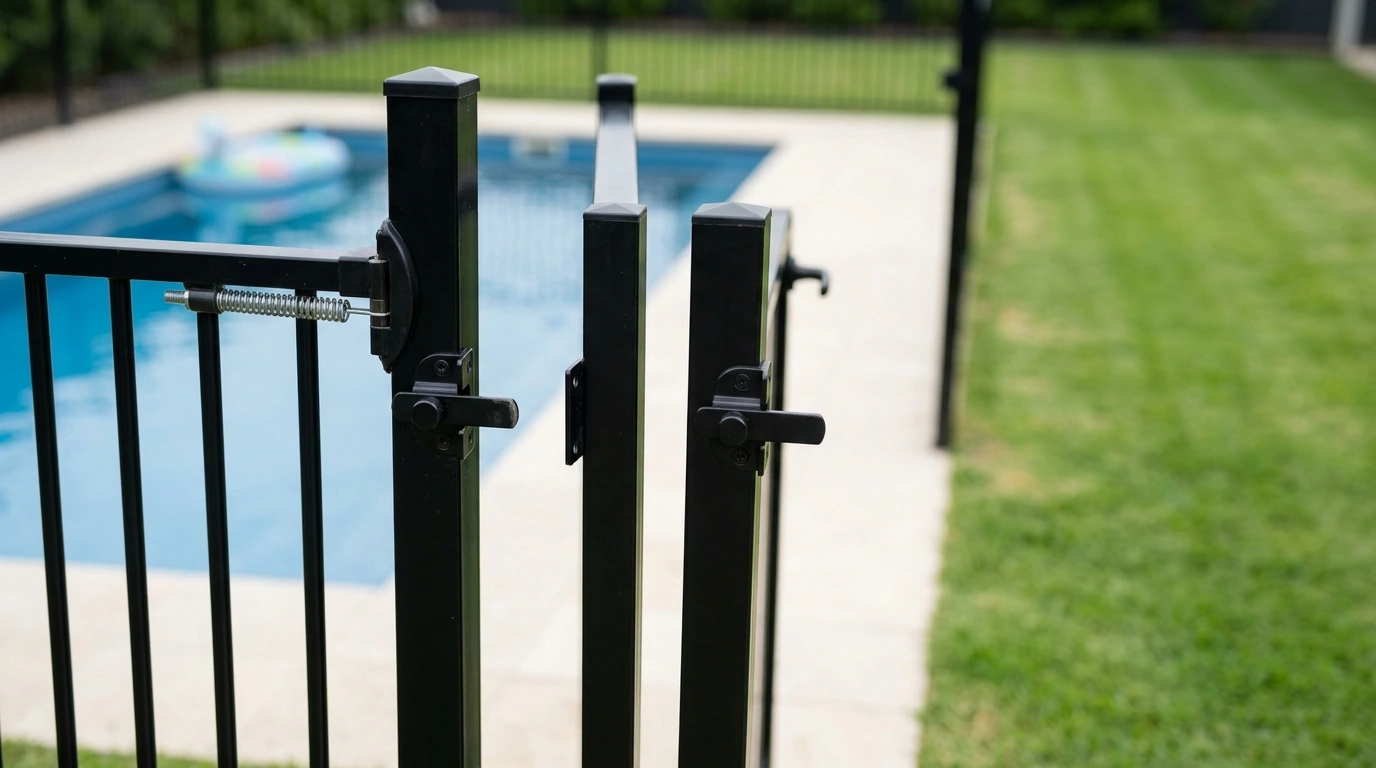
A pool gate not self-closing is a safety fault and a compliance failure in Victoria. Most cases come from weak hinge tension, a sagging gate or a latch that no longer lines up.
The gate must close and latch by itself from any position, even when it is only open a few centimetres.
This blog shows how to test your gate in 30 seconds, match the fault to the right fix, and spot when it is time to call a pro.
Why Is My Pool Gate Not Closing? (Short Answer)
Most gates stop closing for one of five reasons. The hinge spring has weakened, or the gate has sagged. The latch may no longer line up with the striker.
A post may have moved, or something may be rubbing or catching the gate. Each cause needs a different fix, so if your pool gate won’t close or latch, find the cause before you adjust anything.
In Victoria, a gate that does not close and latch on its own from every open position is a non-compliant barrier. It is also one of the most common reasons pools fail inspection.
Do the 30-Second Gate Test First
A gate can pass when it is wide open and still fail when it is just ajar. That is why this test uses three starting positions. Release the gate from each one without pushing it, and it must close and latch every time.
- Fully open. Swing the gate as wide as it goes, then let go. It should close and click shut.
- Halfway open. Let go at about the halfway point. The hinge has less swing to build speed here.
- Just ajar. Open it a few centimetres and let go. This is the toughest test, because the hinge has the least room to push the latch home.
Repeat each position three times. Test on a calm day, because wind can hide a weak hinge.
Each failure looks different, and each one points to a different fault.
- The gate stops short. It slows down and halts before it reaches the latch. This points to weak hinge tension or something dragging on the gate.
- The gate bounces off the latch. It hits the latch, springs back and drifts open. This usually means the hinge is set too hard or the latch is worn.
- The latch misses the striker. The gate closes fully, but the latch sits above, below or beside the striker. This is an alignment fault, often from a sag or a moved post.
This test is an owner’s check, not a replacement for an inspection. It shows you what to fix. Only a formal pool compliance inspection confirms that the whole barrier passes.
Common Causes, Matched to the Symptom
A pool fence gate not closing can come from many small faults. Use this table to match what you saw in the test to the likely cause. Then read the matching section below.
| What you see | Likely cause | Usual fix |
| Gate drifts slowly and stops short | Weak hinge tension, or drag on the gate | Add tension in small steps, or clear the drag |
| Gate closes but the latch misses | Latch and striker out of line, a sag, or a moved post | Fix the sag or post first, then realign the latch |
| Gate bounces off the latch | Hinge set too hard, or a worn latch | Ease the tension, or replace the latch |
| Gate scrapes the ground or fence | Dropped gate, swollen timber, or raised paving | Rehang the gate, ease the timber, or fix the ground |
| Gate fails only on wet or cold days | Swollen timber, or slow soft close hinges | Ease the timber, or check the hinge maker’s advice |
| Gate only closes if you push it | Post movement, or something catching | Check the post and clear the swing path |
Hinge Spring Tension Has Weakened
Self-closing pool gate hinges use a spring, and springs lose force over the years. A gate that once snapped shut may now drift and stop short of the latch. Many spring hinges have a tension screw or collar near the top of the hinge barrel.
To adjust self-closing pool gate hinge tension, follow the maker’s instructions and turn the adjuster a quarter turn at a time. Test from all three positions after each turn. Stop as soon as the gate latches without slamming.
If the collar spins with no resistance or the tension will not hold, the spring has failed and the hinge needs replacing.
The Gate Has Dropped or Sagged
A sagging pool gate hangs lower on the latch side. The latch then hits below the striker, or the bottom rail drags on the ground. Loose hinge screws, a heavy gate, a frame out of square and a leaning post are the usual causes.
Tighten loose hinge fixings first, then test again. Do not move the latch to chase a dropped gate. That hides the fault and puts more strain on the hinges.
The Latch and Striker No Longer Line Up
The latch tongue must meet the striker at the right height, distance and angle. A few millimetres of drift can leave you with a pool gate not latching, even when it closes fully. Close the gate slowly and watch where the latch lands. It may miss high, low or to one side.
Some latches and strikers have slotted holes for small moves. If the maker allows it, move them a little at a time and keep the screws tight. If the latch only lines up when you lift or push the gate, the gate or post has moved. In that case the latch is not the real problem.
The Post or Glass Spigot Has Moved (Footings, Reactive Clay Soil)
Posts and spigots hold the gate and latch in line. When one moves, the two drift apart. Reactive clay soil swells when wet and shrinks when dry. Footings and paving on this kind of soil can shift with the seasons.
Victorian building regulator guidance also flags gate and latch posts set on separate footings. Over time they can spread apart, and the gate stops latching. Push each post gently.
Look for a gap that is wider at the top, cracked paving or a lifted base plate. A moved post is not a DIY job. It needs a fencer or glazier, and it may need a building permit (see the permit section below).
The Gate Is Rubbing on Paving, Mulch, Grass or the Fence
Even light drag can stop a self-closing hinge in the last few centimetres. Walk the gate through its full swing and look for scuff marks. Raised paving, built-up mulch, long grass and a leaning fence panel are the usual culprits.
Clear the mulch and grass first. The gap under a pool barrier must stay at 100mm or less. Never fix a rub by lifting the gate so far that the gap grows past that limit.
Timber Has Swollen or Warped in Wet Weather
Timber takes on water and swells. Melbourne’s wet winters and springs can make a timber gate bind on its post or the ground. A warped gate can also twist the latch out of line.
Let the timber dry, then check where it rubs. You can lightly plane a swollen edge and reseal the bare wood. A warped or rotten frame needs replacing, because it will keep pulling the latch out of line.
Soft-Close Hinges Slow Down in Cold Weather
Soft close pool gate hinges slow the final part of the swing. Some models may react to cold weather, so a gate that closes well in the afternoon can stop short on a cold morning.
This depends on the hinge model, so check the maker’s guidance before you change anything. Do not add lots of tension to force it. Suppose your gate stops short only on cold mornings. Test it again once it warms up. If the fault repeats, ask a fencer to check the hinge.
Something Is Catching It (Wind, Pool Toys, Plants, Added Bolts or Padlocks)
Small things can stop a gate from latching. Wind can hold a light gate off the latch, and pool toys can wedge under the leaf. Plants can grow into the swing path. A bolt or padlock added later can also snag the gate or the striker.
Clear the swing path and remove anything that was not part of the original hardware. If wind is the issue, ask a fencer about stronger hinges. More tension can make the gate bounce off the latch.
How to Fix It by Gate Type
The safe fix depends on what your gate is made of. Owners can handle small adjustments and cleaning on any type. Posts, footings, cracked glass and new hardware belong with a tradesperson.
Frameless Glass Gates
A glass pool gate not closing is usually a hinge tension or spigot problem. Both are quick to check.
- What you can adjust. Many glass gate hinges have a tension screw or dial. Use the maker’s tool, turn a little at a time and retest. Check that nothing rubs the glass edge. Wipe dirt off the latch and hinge with a dry brush.
- What needs a glazier. Call a glazier for a loose or leaning spigot, a hinge that will not hold tension, or any chip or crack in the glass. Chipped glass can break further, so do not leave it.
Check the latch too. Western Australia’s Building and Energy division has warned about key-lock latches on frameless glass gates that can stay locked in the open position.
The notice covers unbranded, imported latches with a key lock. It says they do not meet AS 1926.1-2012 and were supplied across Australia. To check yours, open the gate and twist the latch release at the striker. If the latch stays locked open, replace it.
Aluminium and Steel Tubular Gates
Tubular gates are light and simple, so faults show up fast. Most use spring hinges and a magnetic or mechanical latch.
- What you can adjust. Set hinge tension with the top adjuster and the maker’s steps. Tighten loose hinge and latch screws where the metal is sound. Clean the latch and striker, and make small moves on slotted holes.
- What needs a tradesperson. Call a fencer for a bent or twisted frame, a cracked weld, badly rusted hinges or posts, or a loose post. Call one too when a hinge will not hold tension or the gate is too heavy for its hinges.
Timber Gates
Timber gates move with the weather, so most faults are swelling or sag. They are also the easiest gates for an owner to adjust. Timber gates still need pool-grade self-closing hinges and a pool latch, because a standard garden hinge will not close the gate on its own.
- What you can adjust. Tighten hinge screws, plane a swollen edge, reseal bare wood and fine-tune hinge tension. Small latch and striker moves are fine too.
- What needs a tradesperson. Call a fencer for a rotten or split frame, hinge screws that no longer grip, a rotting post, or a gate that will not hang square.
“Fixes” That Make Your Barrier Non-Compliant
Some quick fixes solve the annoyance and break compliance. Each of these four removes or weakens the barrier, so avoid them.
- Propping or tying the gate open. A gate that is propped open is an automatic fail, and it leaves the pool with no barrier. A hardware maker’s survey, reported by Kids Alive, found that about a third of owners admit to doing it.
- Adding a bolt that works instead of the self-latch. The gate must latch on its own. A bolt only works if someone remembers to slide it, so the gate fails the moment someone forgets.
- Removing the spring to stop the gate slamming. Without the spring, the gate no longer closes on its own. Ease the tension or fit a soft close hinge that still latches every time.
- Over-tensioning until the gate bounces off the latch. Too much force makes the gate hit the latch hard and spring back open. It also wears the hinge out faster.
When to Call a Fencer or Glazier
Small drift can often be adjusted. Once the hardware or structure has failed, replacing beats adjusting. Call a fencer for metal or timber gates and a glazier for glass.
Replace rather than adjust when you see any of these signs.
- The hinges are worn out. The tension will not hold, the collar spins freely, or a hydraulic hinge leaks.
- A post is bent or loose. No latch adjustment can fix a post that keeps moving.
- A footing has moved. Cracked or lifted concrete around a post shows that the base has shifted.
- The glass is chipped or cracked. A glazier should assess it straight away.
Our guide to pool compliance issues that stall a sale puts a gate or latch adjustment at about $100 to $300. Post and footing work costs more. Ask for hardware made for pool gates. On barriers built from 1 May 2013, new hinges must not stick out more than 10mm or leave a gap over 10mm between the gate and the post.
What Victorian Rules Say About Pool Gates
In Victoria, keeping the barrier compliant is the owner’s job at all times. The Building Regulations 2018 require owners to take all reasonable steps to keep the barrier properly maintained, as the Building and Plumbing Commission explains. Your four-yearly certificate does not pause that duty, so the gate must work every day between inspections.
AS 1926.1 sets the gate basics. The table below follows the Victorian self-assessment checklist for barriers built from 1 May 2010. Our AS 1926.1 guide covers the rest of the standard.
| Gate rule | What it means for you |
| Swing direction | The gate opens away from the pool area. |
| Self-closing | It returns to closed from any position, from a standing start, with no manual force. |
| Self-latching | The latch engages by itself and stays shut until released. |
| Latch release height | At least 1500mm above the ground, or shielded for at least 450mm around the release with no opening over 10mm. |
| Latch design | It cannot be adjusted without tools or locked in the open position. |
| Hinges (barriers from 1 May 2013) | They stick out no more than 10mm, and the gap between the gate and post is no more than 10mm. |
Older pools are assessed against the standard that applied when they were built. A pool built in 1995 is not judged the same way as one built in 2015. Your council sets the standard when the pool is registered, and it should appear on your registration notice. Read how the build date decides your barrier rules for the date bands.
If the gate fails an inspection, the inspector gives you a written notice and up to 60 days to fix it. You then book a re-inspection. If the barrier is still non-compliant after 60 days, the inspector must issue a Form 24, and your council can take enforcement action.
An inspector can issue a Form 24 straight away when the barrier is a serious risk. Read what happens after a failed pool inspection for the full process.
Does Replacing a Gate, Hinge or Latch Mean a New Permit or Certificate?
A like-for-like hinge or latch swap is usually maintenance, not an alteration. It normally needs no building permit. Work on posts or footings is different.
The BPC’s practice note BP 01 says a permit is not needed to replace or alter part of a barrier to fix a fault found at inspection. The exceptions include work on posts or footings, more than half the barrier’s length, unusual materials, a change to the enclosed area and retaining walls.
Councils word it differently. Greater Dandenong says a building permit is needed to alter a barrier. Surf Coast Shire says the same but excludes maintenance of hinges and latches.
A Form 23 is issued by an inspector after an inspection. A repair on its own does not issue one. If you fix a fault after a failed inspection, the inspector issues the Form 23 at re-inspection. If your work goes past a like-for-like swap, check with your council building department before you start.
A Simple Gate Check Routine for Melbourne Seasons
A monthly test takes two minutes and catches drift early. Melbourne’s weather then adds a few seasonal checks. Use the table below as a yearly routine.
| When | What to check | Why it matters |
| Every month | Run the 30-second test three times from all three positions. Wipe dirt off the latch and hinge. | Small drift is easy to fix before it becomes a fail. |
| Winter (June to August) | Check timber for swelling and the ground near posts for movement. Our winter pool care checklist covers the rest of the pool. | Wet ground and wet timber can push a gate out of line. |
| Spring (September to November) | Look for storm damage such as leaning posts, loose hinge screws and debris in the swing path. | Wind and storms can shift posts and loosen fixings. |
| Summer (December to February) | Retest before parties and make sure nobody props the gate open. Our summer pool safety checklist helps here. | Heavy use wears hinges, and gates get propped open at parties. |
| Before your four-yearly renewal | Walk the whole barrier with a pool safety checklist and fix small faults early. | A clean pre-check gives you the best chance of passing first time. |
Not Sure Your Gate Will Pass?
A pre-inspection consultation checks your gate against the standard before the official visit, so faults get fixed early.
If you would like a second opinion, you can book a consultation with Local Pool and Spa Inspection.
Frequently Asked Questions About Pool Gates That Won’t Self-Close
How Do I Adjust a Self-Closing Pool Gate Hinge?
Follow the hinge maker’s instructions, because designs differ. Many spring hinges have an adjuster near the top of the hinge barrel that you turn with a flat-head screwdriver or Allen key. Turn it a quarter turn at a time and retest from three positions. Stop as soon as the gate latches without slamming.
Why Does My Pool Gate Close but Not Latch?
The latch and striker have usually drifted out of line. This often happens because the gate has sagged or a post has moved. A dirty or worn latch, or a hinge set too soft, can also cause it. Check where the latch lands, and call a fencer if a post has shifted.
Can I Spray WD-40 on Pool Gate Hinges?
Follow the hinge maker’s advice, because some hinges and latches should not be oiled. Some latch instructions ban oil-based lubricants and allow only powdered graphite. Check the instructions before you spray anything, including WD-40. If the hinge or latch still sticks after you brush off dirt and sand, it is probably worn.
What Height Does a Pool Gate Latch Need to Be in Victoria?
For most Victorian barriers, the latch release must be at least 1500mm above the ground. If it is lower, it needs a shield that covers at least 450mm around the release, with no opening over 10mm. Older pools follow the standard from when they were built, so check your council registration notice.
Which Way Must a Pool Gate Swing?
A pool gate must swing away from the pool area. It must also self-close and self-latch from any position. If yours opens toward the pool, a fencer needs to fix or replace it.
Will My Pool Fail Inspection If the Gate Doesn’t Self-Close?
Yes. A pool gate not self-closing fails the gate item, because the gate must self-close and self-latch from any position. You then get a written notice and up to 60 days to fix it and be re-inspected. If it is still non-compliant after 60 days, the inspector must issue a Form 24.
Can I Put a Padlock on My Pool Gate?
A padlock cannot replace the self-latch. The gate must still close and latch on its own, and no lock can hold the latch open. If you want a lock, use a pool-grade latch with a built-in key lock. Then test that it cannot stay locked open.