
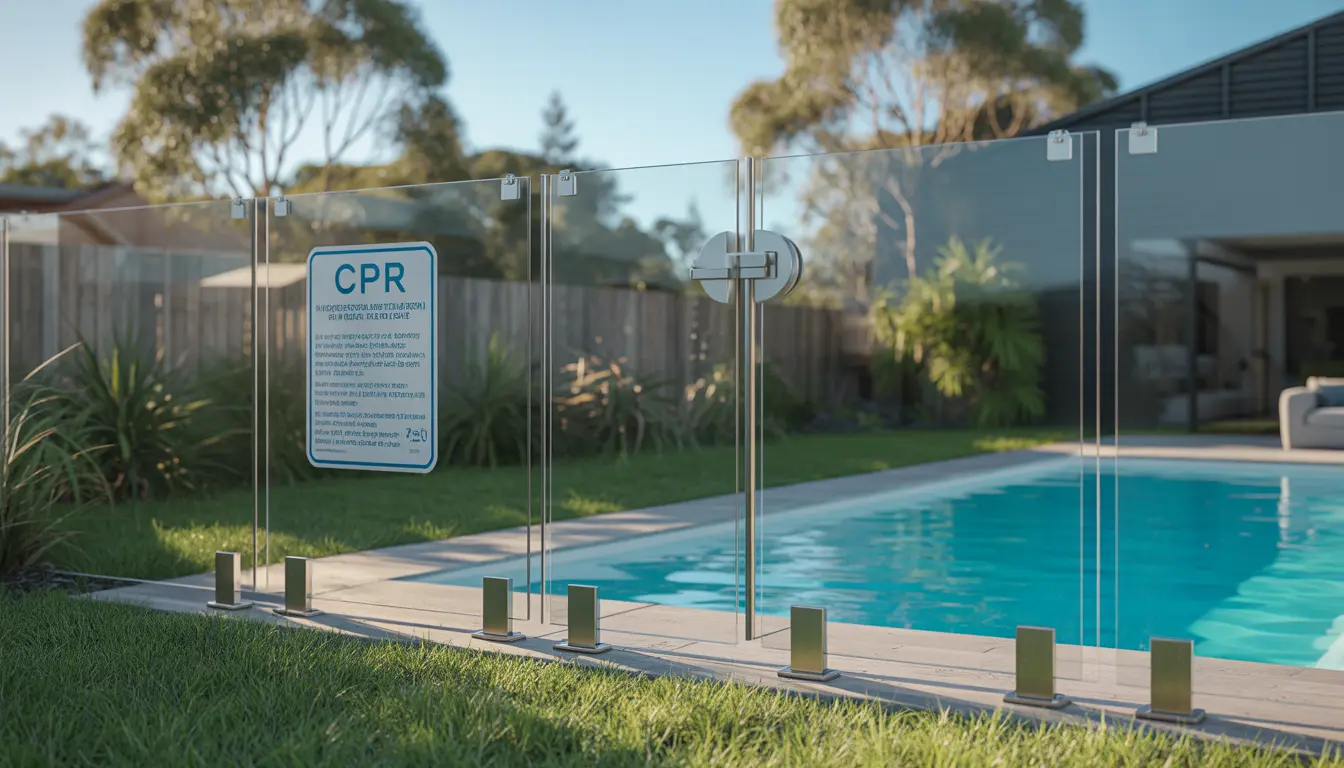
Steering pool safety in Victoria requires strict adherence to AS 1926.1, the Pool Inspection Guide, to ensure every barrier, gate, and latch meets legislative standards.
LPASI’s Today’s Complete Guide outlines the critical transition from the 2012 standards to the recent 2024 revisions, highlighting the non-negotiable requirements for fences, gates, and Non-Climbable Zones (NCZ).
By understanding the role of a VBA Registered Pool Inspector, homeowners can identify common failure points, such as gate latch malfunctions or climbable objects near the barrier.
The piece provides a step-by-step roadmap for preparing for a pool barrier inspection in Melbourne, managing paperwork such as Forms 23 and 24, and ensuring long-term backyard safety through professional Melbourne pool fence inspections.
Understanding the Standard: AS 1926.1:2012 vs. the 2024 Revision
The Australian standard AS 1926.1 is the primary safety benchmark for swimming pool barriers, and the 2012 version remains the most widely cited for existing pools.
However, the 2024 revision introduces more refined definitions regarding material durability and barrier height consistency.
The AS 1926.1 Pool Inspection Guide dictates that a barrier must be a permanent structure designed to restrict access by young children to the pool area.
While the 2012 standard focused heavily on the physical dimensions of the fence, the 2024 updates provide clearer guidance on shielding for gates and the specific strength requirements for glass balustrades.
For a homeowner, the most important factor is knowing which version applies to your pool. In Victoria, the applicable standard is usually determined by the date your pool was constructed or by the date of the last major barrier alteration.
A pool barrier inspection will verify whether your older fence needs to be retrofitted to meet current safety expectations or maintain a deemed-to-satisfy status under its original installation year.
| Feature | AS 1926.1:2012 Requirements | 2024 Revision Key Notes |
| Minimum Fence Height | 1200mm from finished ground level | Reinforced consistency for sloping ground |
| Gate Self-Closing | Must close from any position | Enhanced testing for latch durability |
| Ground Clearance | Maximum 100mm gap | Stricter measurements for soft ground (soil/mulch) |
| Non-Climbable Zone | 900mm radius | Refined definitions for boundary fence intersections |
The Core Compliance Pillars: Fences, Gates, and NCZs
To achieve a pool certificate of compliance, your barrier must master three specific areas: the strength of the fence, the reliability of the gate, and the integrity of the Non-Climbable Zone (NCZ).
The AS 1926.1 Pool Inspection Guide requires that any fence must be at least 1200mm high with no gaps larger than 100mm.
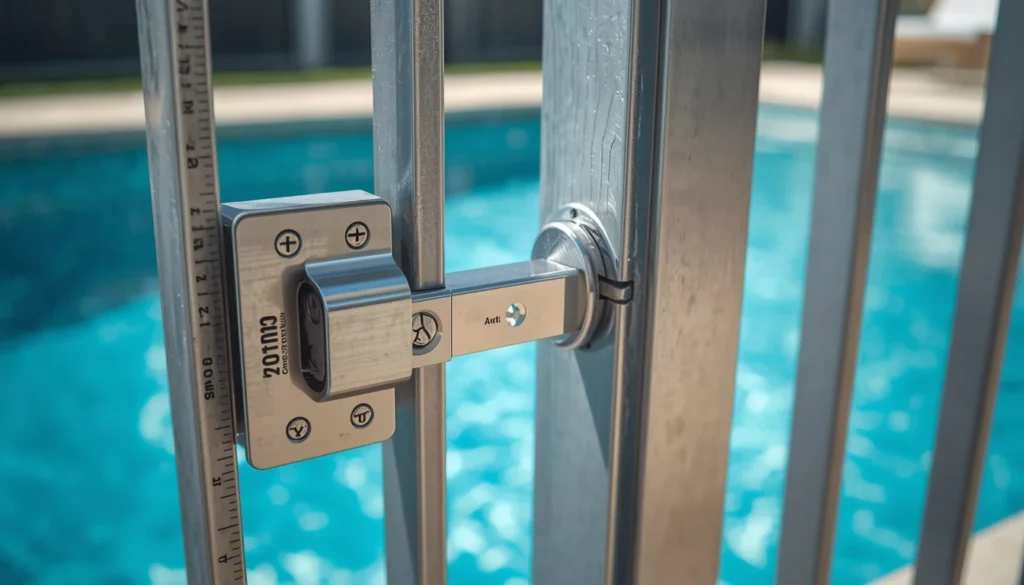
The gate is the most common point of failure. According to modern pool safety standards, every pool gate must be self-closing and self-latching from every open position, even when resting just an inch from the latch.
Furthermore, the NCZ is a 900mm arc where no climbable objects, such as pot plants, chairs, or low-hanging branches, can exist.
If a child can use an object to gain leverage and climb over the fence, the barrier is deemed non-compliant. During a pool barrier inspection in Melbourne, the inspector will use a standardised template to ensure this 900mm zone is completely clear of footholds or handholds.
Inspector’s Secrets: Why Most Pools Fail (And How to Fix It)
Most pools fail their initial pool fence safety inspections due to minor maintenance issues rather than major structural flaws.
The AS 1926.1 Pool Inspection Guide highlights that shifting ground, weathered timber, and loose hinges are the primary culprits.
For example, a wooden gate might sag over time, causing the latch to misalign by just a few millimetres, which immediately voids its safety status.
Another secret is the vegetation growth. A small shrub planted near the fence two years ago might now have branches thick enough to act as a ladder.
To fix these issues before your pool inspector Melbourne arrives, ensure all screws are tightened, hinges are lubricated with weather-resistant grease, and any climbable trees are trimmed back.
Preparing for the Big Day: Your Pre-Inspection Checklist
Preparation is the difference between an immediate pass and a costly re-inspection. Before your scheduled appointment, it pays to walk through your property with fresh eyes and treat it the way a VBA Registered Pool Inspector would.
The AS 1926.1 standard sets out the technical benchmarks that every pool barrier in Victoria must meet, and familiarising yourself with those benchmarks before inspection day gives you the best chance of sailing through without issue.
A simple DIY audit of your backyard can uncover problems that would otherwise trigger a failed inspection and a re-booking fee.
Checking Your CPR Signage
A current, legible CPR sign is a non-negotiable requirement under Victorian law and must comply with the state’s mandated resuscitation signage standards as part of every pool barrier inspection.
The sign must display the approved resuscitation sequence for infants and children and must be positioned so that it is clearly visible from the pool area at all times.
Sun exposure, moisture, and general weathering can fade signage over time, making the text difficult to read.
Before your inspection, stand at the pool edge and check whether every line of text and every illustration on the sign remains sharp and legible.
If the sign is peeling, cracked, or faded to the point where any detail is unclear, replace it before the inspector arrives. Signs are inexpensive and widely available at pool supply retailers across Melbourne.
Testing Your Pool Gate
Your pool gate is one of the most scrutinised components of any inspection. Inspectors test it under multiple conditions, and so should you before they arrive.
| Test Scenario | What to Check |
| The gate opened fully | Swings shut completely and latches without manual assistance |
| The gate opened halfway | Returns to closed position under its own weight |
| The gate opened slightly | Clicks shut even from a minimal opening angle |
The gate must be self-closing and self-latching from every position. If it sticks, drags along the ground, or fails to latch even once during your test, adjust the hinges, clear any obstructions from the base, or call a pool fencing specialist to assess the mechanism before your inspection date.
Measuring Fence Gaps and Clearances
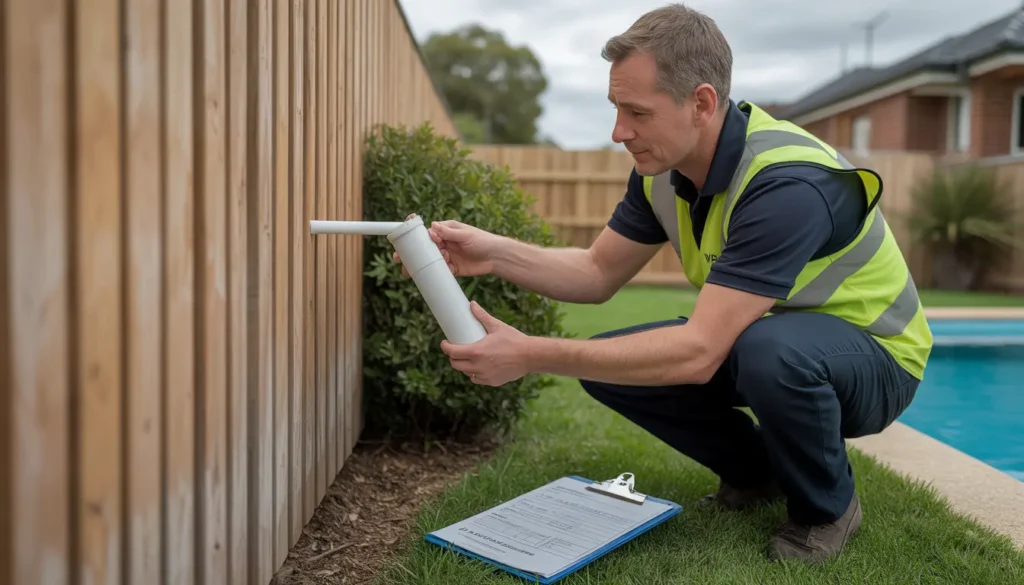
AS 1926.1 specifies strict limits on gaps within and beneath your pool fence. Any opening that allows a 100mm-diameter object to pass through is a non-compliant barrier.
A practical way to test this at home is to use a large coffee mug or a 100mm PVC pipe offcut and systematically work your way around the entire perimeter.
Check the following areas with particular care:
- Pay close attention to the gap beneath the fence line, since ground settlement and erosion can create clearances that were not present when the fence was first installed.
- Also, inspect corners, gate posts, and any sections where panels join, as these junctions are common spots for gaps to develop.
- Horizontal rails closer than 900mm apart on the outside face of the fence can also create a climbable surface, which is one of those frequent safety barrier defects that trigger a compliance failure.
Clearing the Non-Climbable Zone
The non-climbable zone (NCZ) is the 900mm band measured horizontally from the outside face of your pool fence.
No object within this zone should offer a foothold or handhold that could help a child climb over the barrier.
Common NCZ violations found during pool barrier inspection Melbourne assessments include:
- Outdoor furniture such as chairs, tables, and sun loungers positioned against or near the fence presents a serious climbability risk and must be moved outside the 900mm boundary.
- Garden pots, planters, and ornamental features should be relocated for the same reason.
- Children’s equipment, including bikes, play sets, and even stacked toys, can provide the boost needed to get over a fence that otherwise meets height requirements.
- Garden tools and equipment leaning against the fence are also a frequent cause of failed inspections.
- Clear the entire NCZ on the day before your inspection, and keep it clear on the day of your inspection.
Confirming Latch Height and Shielding
The gate latch is a critical safety component because it is the mechanism a child would need to operate to enter the pool area unsupervised.
Under AS 1926.1, the latch release must be positioned at least 1500mm above the ground, or it must be shielded so that it cannot be reached or operated from the outside by a young child.
Before your inspection, measure the latch height from ground level to the point where pressure must be applied to release it.
If the latch sits below 1500mm, it must be shielded on the outside with a barrier that prevents a child from reaching through, around, or over to operate it.
Verify that any existing shielding is intact, securely fixed, and free from damage. A loose or broken shield offers no meaningful protection and will be flagged during the inspection.
The Path to Your Pool Compliance Certificate
Completing this pre-inspection checklist does more than save time on the day. It demonstrates to your VBA Registered Pool Inspector that the property has been actively maintained to a compliant standard, and it significantly reduces the likelihood of needing a re-inspection before your pool compliance certificate Melbourne is issued.
Properties that present well from the outset tend to move through the compliance process far more smoothly than those where basic issues are discovered during the assessment itself.
The Paperwork: Form 23, Form 24, and Council Lodgement
The legal aspect of pool safety involves specific documents that must be handled with precision. In the AS 1926.1 Pool Inspection Guide, Form 23 is the Certificate of Pool and Spa Barrier Compliance issued after a successful inspection.
Conversely, if your pool fails and the issues are not corrected within the allotted timeframe (usually 60 days), the inspector is legally required to initiate the formal failed compliance notice procedures and issue a Form 24 Notice of Non-Compliance.
Once you receive your Form 23 from a pool inspector in Melbourne, you must finalize the process by lodging your swimming pool council registration along with the certificate.
Most councils charge a small administrative fee for this lodgement. Failure to lodge the certificate within the state-mandated deadline can result in significant fines, often exceeding $1,500.
It is vital to remember that a pool certificate of compliance is typically valid for four years in Victoria, after which the cycle repeats to ensure ongoing safety.
Final Reflections on AS 1926.1 Pool Inspection Guide
Maintaining a compliant pool is a continuous responsibility that extends beyond the four-yearly inspection cycle.
By following the AS 1926.1 Pool Inspection Guide, you protect your family, your guests, and your legal standing as a property owner.
Whether you are checking your gate hinges or clearing away climbable garden furniture, every small action contributes to a safer community.
Remember that a pool barrier inspection Melbourne is not just a regulatory hurdle but a vital check-up for the most dangerous area of your home.
Stay informed, stay compliant, and enjoy your pool with a relaxed mind.
Frequently Asked Questions
How often do I need a pool inspection in Australia?
In Victoria, a professional inspection and compliance certificate is required every four years under current regulations.
What is a Non-Climbable Zone (NCZ) for a pool fence?
The NCZ is a 900mm area outside the pool fence that must be completely free of climbable objects.
Can a house door be part of a pool barrier for an outdoor pool?
In Victoria, for pools built after 2010, a house door cannot form part of the pool barrier.
Does a shared boundary fence need to be 1800mm high for pool compliance?
Yes, a boundary fence used as a pool barrier must reach 1800mm high under AS 1926.1 requirements.
What happens if my pool fails its safety inspection?
Your inspector will provide a report, and you have 60 days to fix all non-compliant items identified.
Is an inflatable pool required to have a compliant barrier?
Yes, any pool holding more than 300mm of water requires a fully compliant safety barrier without exception.
How much does a registered pool inspector cost in Melbourne/Sydney?
Standard professional pool safety assessment rates in Melbourne typically range between $150 and $350 for an initial inspection.
Do I need a building permit for pool fence repairs?
Minor repairs rarely require a permit, but major fence replacements or relocations generally do under current codes.