
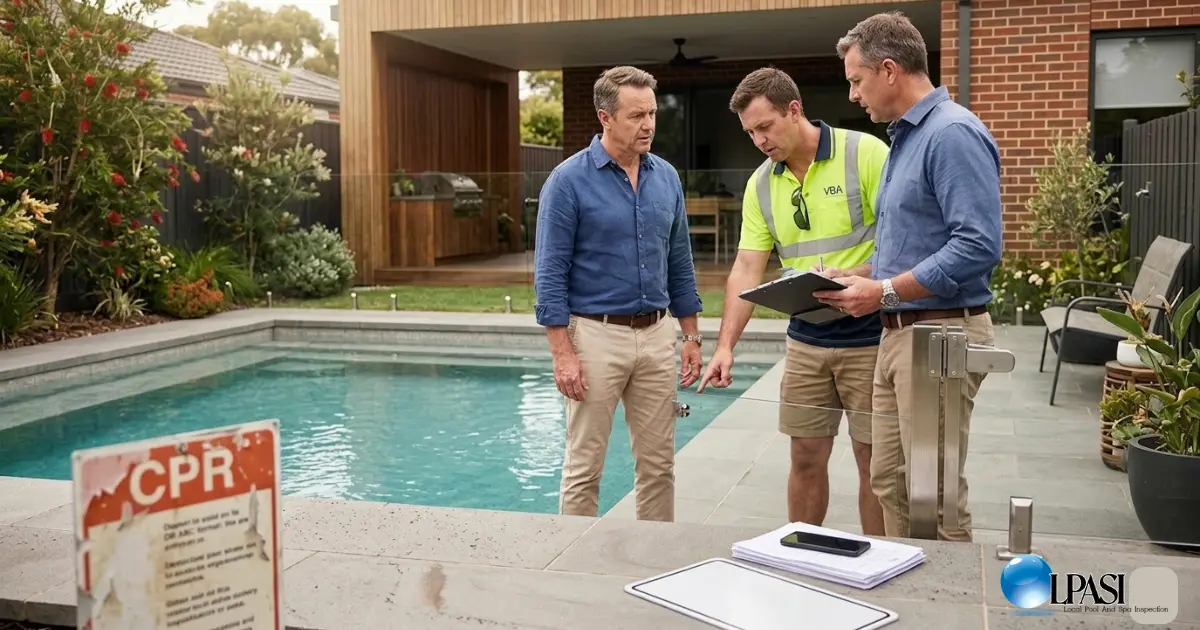
Most Australian pool sellers don’t realise their pool is non-compliant until a buyer is already waiting. By then, the clock is ticking, and the contract is at risk.
Around 104 Australians drown every year in backyard pools and waterways.
Regulators respond with strict compliance rules. And the data backs it up: the overwhelming majority of pools fail their first inspection.
That means fines, delays, and settlements that fall apart at the worst possible moment.
The fix is simple. Get a pool compliance inspection before you list, not after you sign. This guide gives you a state-specific roadmap to catch problems early, fix them fast, and close without a single hiccup.
Why Pool Compliance Is the Deal-Breaker in Modern Real Estate
Pool compliance has moved from a bureaucratic checkbox to a genuine deal-breaker in Australian real estate.
A valid compliance certificate is now a legal prerequisite for settlement in every major state.
Buyers, conveyancers, and agents are increasingly sharp on requirements; a missing or expired certificate gets flagged immediately, often at the worst possible moment in the settlement process.
The Legal Reality: You Cannot Settle Without a Certificate
The short answer to “Do I need pool compliance to sell?” is yes.
In NSW, a Certificate of Compliance must be annexed to the Contract of Sale under the Swimming Pools Act 1992.
In QLD, a Form 23 Pool Safety Certificate is required before settlement or lease.
In VIC, a Certificate of Barrier Compliance must be lodged with your local council. Under the Sale of Land Amendment Act 2019, Victorian sellers who skip this step face a blocked settlement with no workaround.
There is no grace period. There is no workaround.
The Insurance Risk Nobody Warns Sellers About
If your pool is non-compliant at the time of sale or during occupancy, your home insurer may reject liability claims related to pool incidents. Most sellers never consider this until it’s too late.
Non-compliance signals a known, unmanaged hazard.
Many insurers treat it that way. If something goes wrong before settlement, you could be left personally exposed with no insurance safety net in place.
State-by-State Compliance Requirements at a Glance
| Requirement | QLD | NSW | VIC |
| Certificate Name | Pool Safety Certificate (Form 23) | Certificate of Compliance | Certificate of Barrier Compliance |
| When Required | Before sale/lease | Before sale/lease | Every 4 years, lodge with the council |
| Governing Body | QBCC / Licensed Pool Safety Inspector | NSW Fair Trading / Certified Inspector | Local Council / VBA-registered Inspector |
| Certificate Validity | 2 years (non-shared) | 3 years | 4-year inspection cycle |
| Registration Required | Yes -QBCC Pool Safety Register | Yes -NSW Swimming Pool Register | Yes -Local Council Register |
Top 7 Compliance Red Flags That Stall Settlements
The vast majority of pools fail their first compliance inspection, not due to major structural disasters, but because of small, overlooked issues that quietly compound.
Here are the seven most common culprits.
1. Faulty Gates and Self-Latching Mechanisms
Gate failures are the most frequently cited reason for non-compliance across QLD, NSW, and VIC. Inspectors test the gate multiple times. A single failure to self-latch is enough to block your certificate.
- The gate must self-close from any open position, including 90 degrees
- Latch must sit at a minimum height of 1,500mm, or on the pool side if lower
- Hinge tension must ensure automatic closure with no manual help
- Ground clearance must not exceed 100mm beneath the gate
2. Non-Climbable Zone (NCZ) Violations
The Non-Climbable Zone (NCZ) requires 900mm of clear space outside the pool fence and 300mm inside.
Any object a child could use to climb over becomes your compliance problem. Common offenders inspectors find include garden chairs, sun lounges, potted plants, BBQs, outdoor furniture, tree branches, and step platforms.
A single child-height pot plant placed against the fence is enough to fail your inspection.
3. Fence Height, Gaps, and Structural Deterioration
- Pool barriers must reach at least 1,200mm in height as outlined in our AS 1926.1 pool inspection guide.
- Boundary fences used as pool barriers must reach 1,800mm
- The maximum allowable gap is 100mm at any point along the barrier
- Rust, rot, or corrosion constitutes a structural failure regardless of fence height
Older panels that have sagged, corroded, or shifted over time will fail regardless of how well they were originally installed.
4. Non-Compliant Doors, Windows, and Direct Pool Access
This issue appears most often in older homes where rear doors open directly into the pool area.
- All doors leading to the pool area must be self-closing and self-latching
- Windows that open toward the pool must be limited to a maximum of 100mm or fitted with approved security screens
- No direct, unbarriered access point from the home to the pool is permitted
Renovated or extended homes are particularly vulnerable; additions can inadvertently create new access points that didn’t previously exist.
5. Missing or Outdated CPR Signage, including the 2021 Update Trap
Current CPR signage in DRSABCD format has been required since 2021.
Any older “DR ABC” signage will automatically fail inspection, even if the sign is clean, visible, and professionally mounted.
The sign must be permanently fixed, weather-resistant, and legible at three metres from the pool.
This is one of the cheapest and quickest fixes available, yet it catches hundreds of sellers off guard every year.
Check your sign now before you book your inspection.
6. Boundary Fence Issues and the Neighbour Problem
When a shared boundary fence forms part of your pool barrier, you are responsible for ensuring the entire barrier, including your neighbour’s side, stays compliant.
If the neighbour has climbable objects within the NCZ on their side, it becomes your problem to resolve.
A seller in Melbourne listed their property confidently, only to discover during inspection that a neighbour’s garden bed with mature shrubs directly abutted the shared fence and triggered an NCZ violation.
The fence also needed upgrading from 1,500mm to the full 1,800mm boundary standard, requiring council approval and adding four weeks to settlement.
Walk your boundary fence with your neighbour before you list, not after you sign.
7. Pool Registration: The Step Sellers Forget
Completing and lodging your swimming pool council registration is a legal prerequisite before any compliance certificate can be issued, yet it’s routinely overlooked.
- NSW: Register on the NSW Swimming Pool Register (free, online)
- QLD: Register with the QBCC Pool Safety Register; fines apply for non-registration
- VIC: Register with your local council; unregistered pools attract significant penalties
An unregistered pool cannot receive a certificate. Inspectors are legally required to check registration status on arrival.
The Hidden Danger: Outstanding Council Orders
Council orders are enforcement notices issued when an unsafe barrier is identified through a council audit, complaint, or prior failed inspection.
The danger is that these orders can sit dormant for years, only to surface during a title search at settlement, stopping the sale immediately.
Buyers’ solicitors routinely search for outstanding orders, and any unresolved notices must be cleared before contracts can be completed.
How to Find Out If Your Pool Has an Outstanding Order
Outstanding council orders don’t always show up in routine searches, and many sellers only discover them when a conveyancer flags an issue days before settlement.
The good news is that finding out early is straightforward if you know where to look.
- Search the NSW Pool Register or QBCC portal using your address
- Contact your local council’s building compliance department directly
- Ask your conveyancer to run a full compliance search on the property
- Review all historic council correspondence and rate notices
- Book a pre-inspection with a certified pool safety inspector who will surface any known issues
How Long Can Compliance Issues Delay Your Settlement?
Not all compliance issues are equal; a missing CPR sign can be fixed before your next open house, but a structural barrier problem can push settlement back by two months or more.
The table below maps each common issue to its realistic fix time so you can prioritise what needs attention first.
| Issue | Typical Fix Time | Settlement Risk |
| Gate latch adjustment | 1-3 days | Low |
| CPR sign replacement | 1 day | Low |
| NCZ clearing | 1 day | Low |
| Pool registration | 1-2 days (online) | Medium |
| Fence gap repairs | 1-2 weeks | Medium |
| Fence height upgrade | 2-4 weeks | High |
| Structural barrier rebuild | 4-8 weeks | Critical |
| Council order resolution | 4-12 weeks | Critical |
Strata Sellers: Who Is Actually Responsible for Your Pool Compliance?
In a strata complex, the body corporate is generally responsible for compliance with any pool on common property.
However, sellers must confirm this in writing before listing, reviewing recent AGM minutes and strata manager records to verify current certificate status and any outstanding works orders.
If the pool is tied to a lot, such as a private courtyard pool, responsibility may fall to the individual owner.
Get written confirmation from your strata manager before listing.
Expert Strategies to Fast-Track Your Pool Certification
The most effective way to stop pool compliance from delaying your sale is to start the process well before you list.
Sellers who engage a qualified inspector during campaign preparation save weeks of potential delays and remove one of the most common causes of last-minute settlement stress.
Book a Pre-Inspection Before You List
A pre-inspection by a private certifier lets you find and fix issues before the formal compliance inspection, and before any buyer sets foot on the property.
| Private Certifier | Council Inspector | |
| Turnaround | Same-day or within the week | 3–6 weeks |
| Cost | $200–$270 | Lower, but variable |
| Report Quality | Detailed photos, rectification guide | Basic written report |
| Flexibility | Available for pre-listening audits | Not typically offered |
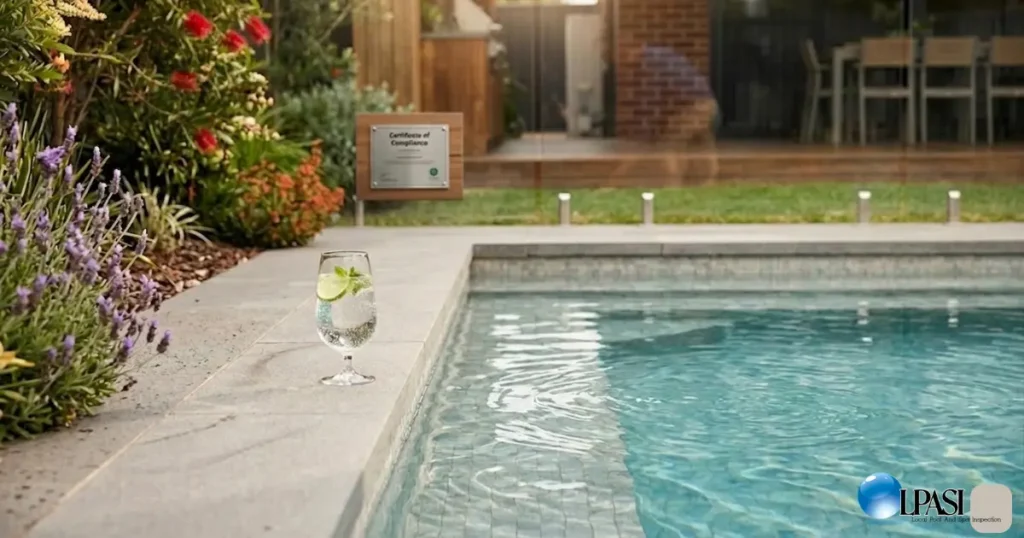
Local Pool and Spa Inspection provides VBA-registered inspections with same-day certificates across 30+ Melbourne councils, the kind of fast, expert service sellers need when time is critical.
How Much Does Pool Compliance Cost in 2026?
The cost of pool compliance depends on where you start.
A straightforward check with minor fixes can cost under $500, but reviewing current professional pool safety assessment rates can help you accurately budget if your fence needs a full-height upgrade or structural work. Here is what to budget for before you list.
| Item | Estimated Cost |
| Initial compliance inspection | $200–$270 |
| Re-inspection fee | $0–$100 |
| Certificate (if issued same-day) | Included |
| Gate/latch adjustment | $100–$300 |
| CPR sign replacement | $20–$60 |
| Fence gap repairs | $300–$1,500 |
| Full fence height upgrade | $2,000–$8,000+ |
What You Can Fix Yourself vs What Needs a Licensed Contractor
Before you call anyone, it’s worth knowing that several of the most common compliance failures are straightforward DIY fixes, no tradesperson required.
The dividing line is generally this: if it involves the structure or height of the barrier itself, or requires council approval, you need a licensed contractor. Everything else is fair game.
DIY-safe fixes:
- Adjusting gate latch tension and position
- Replacing CPR signage with the current DRSABCD format
- Clearing all objects from the NCZ, furniture, pots, and BBQs
- Removing or trimming vegetation within the NCZ
Requires a licensed contractor:
- Increasing fence height to meet 1,200mm or 1,800mm minimums
- Structural barrier replacement or reinforcement
- Installing self-closing mechanisms on doors and windows
- Any work requiring council approval
Pre-Inspection Self-Audit Checklist
- Test the gate self-closes and latches 10 consecutive times from all open positions
- Measure fence height at multiple points, 1,200mm minimum required
- Clear a full 900mm outside the fence of all climbable objects
- Check all fence gaps, maximum 100mm anywhere along the barrier
- Confirm your CPR sign is in DRSABCD format and legible at 3 metres
- Inspect all fence panels and posts for rust, rot, or structural damage
- Test all pool-facing doors for self-close and self-latch function
- Confirm windows restrict to a maximum 100mm opening or have approved security screens
- Verify pool is registered with the NSW Pool Register, QBCC (QLD), or your local council (VIC)
- Check that the pump is running, the filter is clean, and the water is visibly clear
What Happens After a Failed Inspection?
- Receive your report, typically within 24 hours, with photos and rectification guidance
- Rectify all identified issues, work through your report item by item; use licensed contractors where required
- Book your re-inspection; most certifiers can return within days of notification
- Receive your certificate. Once compliant, your certificate is issued, often the same day
Preparing Your Pool for a Winning Open House
A compliant pool is the baseline. At open house, buyers and agents notice the full picture, water quality, equipment condition, and structural appearance, all of which inform their perception of the property’s value and maintenance history.
Water Quality and Chemical Balance
- pH should sit between 7.2 and 7.6 for safe, clear water
- Free chlorine should be maintained at 1–3 ppm
- Water must be visibly clear; algae, cloudiness, or discolouration raises flags with buyers and conveyancers
Equipment, Pumps, and Filters
- The pump should be running and audibly operational during the inspection
- The filter must be clean; a clogged filter signals neglected maintenance
- Check for visible leaks around fittings, valves, and the filter housing
Structural Condition and Visible Cracks
Even minor surface cracking on pool walls or coping tiles can signal structural movement to an informed buyer and to a building inspector.
Address hairline cracks with appropriate sealant before your open house and disclose any known structural repairs transparently to avoid post-sale disputes.
Don’t Let Your Pool Sink Your Sale
Pool compliance issues are among the most preventable causes of settlement delays in Australian real estate, yet they catch sellers off guard every day.
The fix is clear: start early, self-audit your barriers using a local pool safety checklist, and engage a qualified, VBA-registered inspector before your property hits the market.
Local Pool and Spa Inspection offers flat-fee inspections, same-day certificates, and expert rectification guidance across Melbourne’s 30+ councils.
Book your pre-inspection today and go to market with complete confidence.
Key Takeaways for Sellers
- Pool compliance certificates are legally mandatory in QLD, NSW, and VIC before settlement
- The majority of pools fail their first inspection. Book a pre-inspection before listing
- Gates, NCZ violations, and CPR signage are the top three fixable failure points
- Register your pool before booking an inspection; an unregistered pool cannot be certified
- In strata, confirm body corporate responsibility in writing before you sign any contract
Frequently Asked Questions About Pool Compliance and Property Sales
Do I need a pool compliance certificate to sell my house?
Yes. In QLD, NSW, and VIC, a compliance certificate is a legal requirement before settlement can proceed.
How long does it take to get a pool compliance certificate?
An inspection typically takes 30–45 minutes. If your pool is compliant, a private certifier can issue your certificate the same day.
What happens if my pool fails inspection before settlement?
You receive a Certificate of Non-Compliance, valid for 12 months in NSW. You must rectify all issues and arrange a re-inspection before a Certificate of Compliance can be issued.
Can I sell my house with a non-compliant pool?
In some states, yes, with conditions. In QLD, a Form 36 can be issued, transferring responsibility to the buyer. This must be agreed contractually and disclosed upfront.
How much does pool compliance cost?
Initial inspections cost $200–$270 with a private certifier. Rectification works range from under $100 for signage to $8,000 or more for structural fence upgrades.
Does my insurance cover me if my pool is non-compliant?
Not necessarily. Insurers frequently cite non-compliance as grounds to reject liability claims arising from pool incidents.
Who is responsible for pool compliance in a strata complex?
The body corporate holds responsibility for common property pools. Get written confirmation of the current certificate status from your strata manager before listing.