
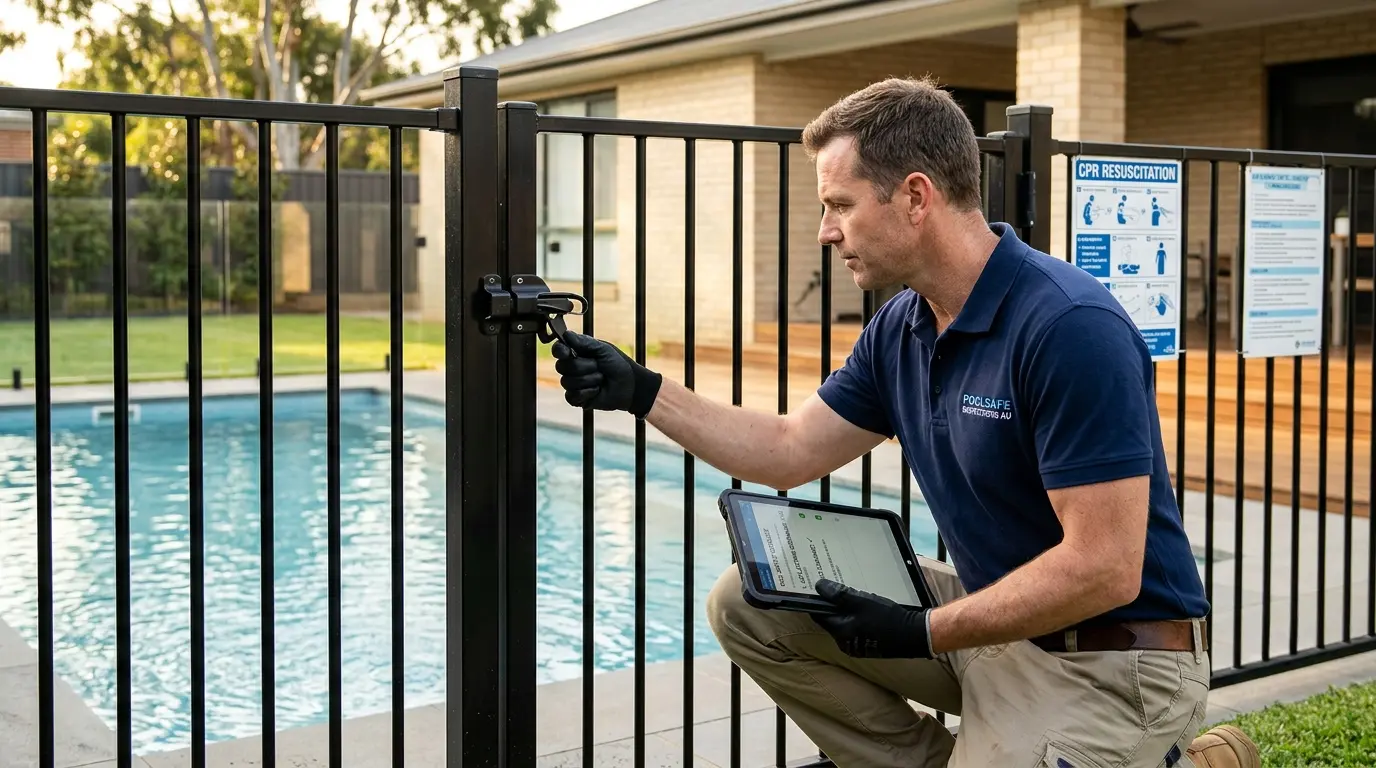
In Victoria, pools most commonly fail an AS 1926.1 safety inspection due to nine major non-compliance issues: self-closing or self-latching gate failures, climbable objects like plants or furniture inside the 900mm non-climbable zone, fence heights under the required 1200mm (or 1800mm for boundary walls), gaps under or between barrier members exceeding 100mm, and non-compliant house doors or windows opening directly into the pool area. Additionally, inspections regularly fail due to a lack of proper isolation fencing, horizontal fence rails spaced too closely to create a ladder effect, missing or illegible CPR resuscitation signage that does not display current DRSABCD guidelines, and unregistered pools or expired Certificates of Barrier Compliance.
Every year, thousands of Victorian pool owners book a professional swimming pool inspection, expecting a quick pass. Unfortunately, many don’t get one.
In this discussion, we have covered the nine main reasons Victorian pools fail AS 1926.1 inspections, detailed exactly what inspectors check, and provided a practical checklist to ensure your barrier passes on the first try.
Why Pools Fail Inspection in Victoria
Most pool inspection failures in Victoria stem from minor, easily overlooked issues like faulty gate latches, reduced fence heights, and climbable objects placed too close to the safety barrier.
What a pool safety inspection legally checks under AS 1926.1 and the Building Regulations 2018
A pool safety inspection in Victoria is a legal requirement, not a courtesy visit. It sits on two pieces of legislation and one technical standard: the Building Act 1993 (Vic), the Building Regulations 2018 (Vic), and the Australian Standard AS 1926.1, which sets the physical rules for the barrier itself – fence height, gate hardware, gap sizes, and the non-climbable zone.
Which edition of AS 1926.1 applies to your pool depends on when it was built or when the barrier was last significantly altered. This is one of the most misunderstood parts of the process, because a barrier built in the 1990s isn’t judged against today’s rules; it’s judged against the rules in force at the time, unless it’s been substantially changed since.
How common failure actually is on first inspection
Barrier failures, on initial inspection, are surprisingly frequent across Victoria, primarily because pool safety standards leave no room for error. A gate latch that sticks just once, a fence that has lost a few centimeters of height due to shifting soil, or a garden pot placed too close to the barrier will trigger an immediate non-compliance result.
Because inspectors are legally bound to evaluate barriers against strict physical criteria, even minor wear and tear or minor backyard setup changes often cause otherwise well-maintained pools to fail their very first check.
Who can carry out the inspection (VBA-registered inspectors only)
Only a VBA-registered pool safety inspector can legally issue a Certificate of Barrier Compliance (Form 23) or a Notice of Non-Compliance (Form 24) in Victoria. Neither a self-assessment nor a general building inspector’s opinion meets the legal requirement.
Following the AS 1926.1 pool inspection guide helps property owners navigate every regulatory step, verify the exact safety standards, and confirm that all physical barriers fully comply before booking a formal site visit.
What a Victorian Pool Barrier Inspection Actually Checks
A Victorian pool barrier inspection evaluates the safety compliance of your physical barrier, gate hardware, non-climbable zone, and signage under AS 1926.1 without assessing pool water, pumps, or structural condition.
Barrier, gate, signage, and non-climbable zone – yes
A Victorian pool barrier inspection is narrow and specific. It checks the fence, the gate, and its hardware, the non-climbable zone around the barrier, and the CPR/resuscitation signage. That’s the full scope under AS 1926.1.
Water chemistry, pumps/filters, electrical, structural cracks – not part of a barrier inspection
Water chemistry, pumps, filters, electrical bonding, and structural cracks in the shell are not part of a barrier compliance inspection. Those fall under a separate pre-purchase or condition assessment, which is a different service entirely.
| Checked in a barrier inspection | Not checked in a barrier inspection |
| Fence height and gaps | Water chemistry |
| Gate self-closing/self-latching | Pump and filter condition |
| Non-climbable zone (900mm) | Electrical bonding |
| CPR signage | Structural cracks in the shell |
| Pool registration status | Heating and automation systems |
Why this confuses homeowners who’ve read US pool inspection guides
Most online pool inspection content is written for the US market, where a “pool inspection” often means a full mechanical and structural review.
In Victoria, a barrier inspection is a legal compliance check on the fence and gate only. If you also want the mechanical, structural, and electrical side covered – especially before buying a property, that’s a separate, broader assessment.
1. Non-Compliant Fence or Boundary Wall Height
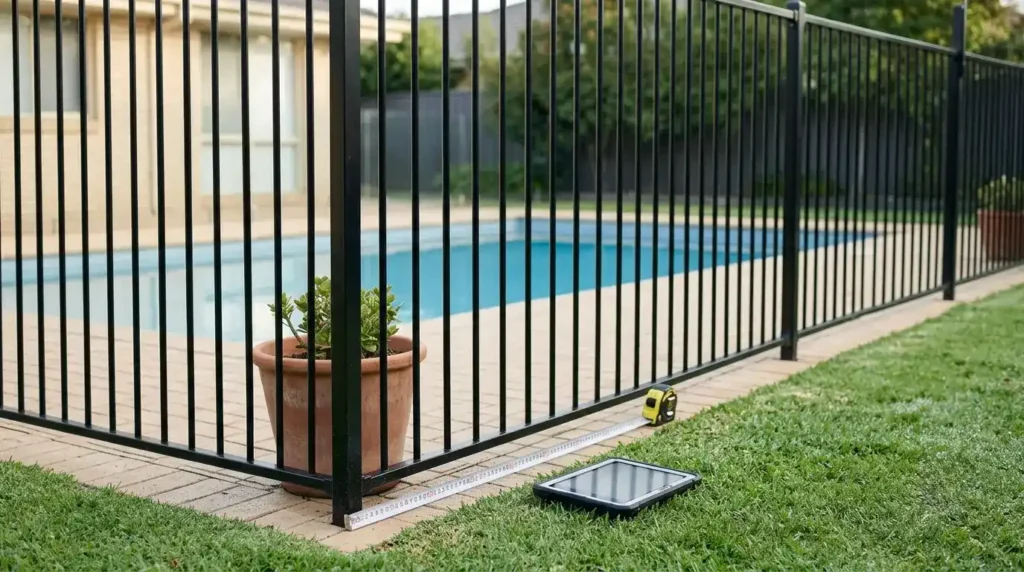
A dedicated pool fence must be at least 1200mm high, measured from the ground on the non-pool side. Where a boundary fence forms part of the barrier, a common setup on smaller Melbourne blocks, the required height increases to 1800mm, with no climbable footholds in the top 900mm.
Height is measured from the lowest point of ground within 900mm of the fence, which is why sloped or uneven sites often fail here. Soil that has settled or eroded over time can quietly drop a compliant fence below the legal height without anyone noticing.
2. Gate That Doesn’t Self-Close or Self-Latch Correctly
The gate is consistently one of the biggest reasons pools fail inspection in Victoria. It must swing away from the pool, never toward it, and it has to self-close and self-latch from every open position, including barely open, not just from wide open.
The latch needs to sit at the correct height, and the self-closing hinge needs enough spring tension to complete the swing every time. The most common on-site fault is simple: a gate propped open with a pot plant, or a latch that’s rusted, painted over, or so stiff it doesn’t fully engage.
3. Climbable Objects Inside the Non-Climbable Zone
Under the current standard, a 900mm non-climbable zone must be kept clear on the outside of the fence. Anything a child could use as a step or handhold inside that zone is a fail, even if the fence itself is perfect.
The usual culprits are pot plants, BBQs, outdoor furniture, air conditioning units, and overhanging tree branches.
This is one of the reasons pools fail inspection more often on reinspection than on the first visit. Owners fix the fence and gate, then push a potted plant back against it, not realizing it’s now back inside the zone.
4. Gaps, Openings, or Under-Fence Clearance Too Large
Vertical gaps between fence members can’t exceed 100mm, and clearance under the bottom rail is capped at 100mm as well. Both numbers exist for the same reason: a small child’s head or body shouldn’t fit through.
Horizontal rails deserve a specific mention. Rails spaced too close together, or positioned at the wrong height, can accidentally create a “ladder effect” that a child can climb, even if every individual gap technically measures under 100mm.
5. Windows or Doors With Direct, Non-Compliant Pool Access
If a door or window opens directly onto the pool area, that opening requires a restriction under AS 1926.1: a self-closing device, a screen, or another approved method that prevents a child from walking straight through.
This is a common fail in older Melbourne homes, where the pool sits close to the back door, and the original build predates today’s isolation requirements.
6. Missing or Incorrect Isolation Fencing
There’s an important difference between isolation barriers, which separate the pool from the house, and perimeter barriers, which enclose the whole property. Victorian regulations generally require isolation fencing so the house itself can’t act as part of the barrier.
Pools built close to the house, a popular layout on newer, smaller blocks, fail here specifically when the builder assumed the house wall counted as compliant fencing. It usually doesn’t.
7. Missing, Incorrect, or Illegible CPR/Resuscitation Signage
Every backyard pool in Victoria needs a compliant CPR sign showing the current DRSABCD resuscitation procedure, positioned so it’s visible from inside the pool area, not tucked behind a shed or hidden by furniture.
Faded, sun-damaged, or outdated signage is one of the most common reasons pools fail on inspection day, simply because owners forget how quickly signs deteriorate in the Australian sun.
>
Meeting all CPR sign pool requirements in Victoria means ensuring the display features the current DRSABCD protocol, remains clear and legible, and is positioned so it can be easily read from anywhere inside the pool area.
8. Missing Pool Registration or Expired Certificate of Barrier Compliance
Every pool and spa in Victoria must be registered with the local council, including older pools that were never registered when they were built. Registration is retrospective, not optional. On top of that, barriers must go through reinspection roughly every four years to keep the Certificate of Barrier Compliance current.
>
An expired certificate becomes a real problem at the point of sale or lease, where it can hold up settlement or trigger a special condition. Knowing what to do after installing a pool in Victoria ensures you stay ahead of these legal requirements, keep your registration on schedule, and avoid costly delays down the line.
What Happens After a Failed Pool Inspection
A failed inspection isn’t the end of the process; it’s a Notice to Comply, with a rectification timeframe attached (commonly 60 days, though serious structural non-compliance can carry a shorter window).
Fix the issues, book a reinspection, and once the inspector confirms compliance, you will receive the Certificate of Barrier Compliance.
If a sale or lease is already underway, understanding what happens if your pool fails inspection becomes critical, as a Notice to Comply can delay property settlement until the barrier is fixed and passed.
Navigating the specific pool compliance issues that delay settlements helps vendors and buyers resolve non-compliant gates, missing signage, or barrier gaps quickly to keep real estate transactions on schedule.
How to Prepare for a Pool Safety Inspection
A little preparation avoids most of the pool safety inspection failures on this list entirely:
- Walk the fence line the day before and remove anything climbable within 900mm of the barrier – pot plants, chairs, toys, garden furniture.
- Test the gate latch by hand three times, not once. Open it slightly and let go, open it fully and let go, and check it fully engages every time.
- Check that the CPR sign is legible from the pool level, not just present. Stand where a swimmer would stand and read it properly.
- Have your existing certificate or registration number ready for the inspector – it speeds up the visit and avoids paperwork delays.
Knowing about the local pool safety checklist before your inspection allows you to systematically inspect every gate, latch, and barrier gap to catch minor issues early.
Book a VBA-Registered Pool Safety Inspection
Local Pool & Spa Inspection (LPASI) is a VBA-registered pool safety inspection service (VBA Registered Building Inspector: IN-L 60437), operating across Melbourne and regional Victoria.
We inspect strictly in accordance with AS 1926.1 and the Building Regulations 2018, and we do not have referral relationships with fencing or repair contractors; what we find is what we report.
If you’d rather avoid the risk of a failed inspection, get in touch with LPASI before your Form 23 is due.
Frequently Asked Questions
What are the most common reasons a pool fails inspection in Victoria?
The gate not self-closing or self-latching properly, climbable objects inside the 900mm non-climbable zone, and non-compliant fence height are the most common reasons pools fail inspection in Victoria.
Does a pool safety inspection check the water or equipment?
No. A Victorian pool barrier inspection only checks the fence, gate, non-climbable zone, and signage. Water chemistry, pumps, filters, electrical bonding, and structural condition are covered by a separate pre-purchase or condition inspection, not the barrier compliance check.
How high does a pool fence need to be in Victoria?
A dedicated pool fence must be at least 1200mm high. Where a boundary fence forms part of the barrier, the required height increases to 1800mm, with no climbable footholds in the top 900mm.
What counts as a climbable object near a pool fence?
Anything a child could use as a step or handhold inside the 900mm non-climbable zone – pot plants, BBQs, outdoor furniture, air conditioning units, and tree branches are the most common examples.
Which way should a pool gate swing?
A compliant pool gate must swing away from the pool area, never toward it, and it must self-close and self-latch from any open position.
Do I need a CPR sign even for a small pool?
Yes. Every backyard pool in Victoria, regardless of size, needs a compliant CPR sign showing the current resuscitation procedure, positioned so it’s clearly visible from the pool area.
What happens if my pool fails its safety inspection?
You’ll receive a Notice to Comply with a rectification timeframe, commonly 60 days. Once the required repairs are made, you book a reinspection, and a Certificate of Barrier Compliance is issued once the barrier passes.
How often do pools need to be reinspected in Victoria?
Pool barriers generally need to be reinspected roughly every four years to keep the Certificate of Barrier Compliance current, in addition to any inspection triggered by a property sale or council request.
Does an older pool need to be registered even if it has never been inspected?
Yes. Pool registration in Victoria is retrospective. Even a pool built decades ago that was never registered still needs to be registered with the local council now, and its barrier must still meet the applicable standard.