
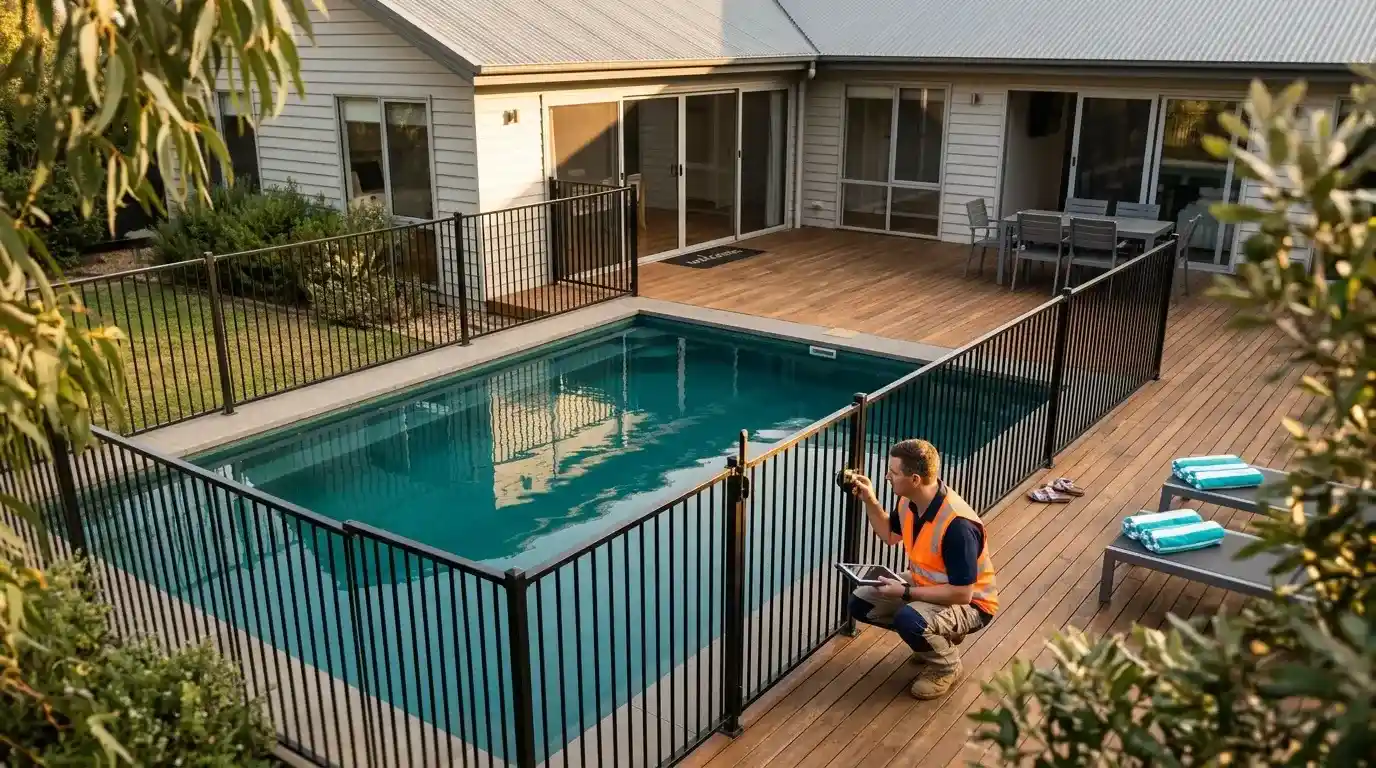
Airbnb and short-stay properties in Victoria must strictly comply with pool safety regulations. Under the Building Regulations 2018 (Vic) and AS 1926.1 barrier standards, any short-stay property with a pool or spa holding 300mm or more of water requires mandatory council registration, a certified barrier, and a renewed Form 23 Certificate of Barrier Compliance every four years.
Achieving full pool compliance for Airbnb properties is critical to host liability, guest safety, and maintaining valid insurance coverage. Booking a certified swimming pool inspection in Melbourne ensures your short-stay barrier meets all current Victorian safety mandates before your next check-in.
Do Airbnb and short-stay properties need pool compliance in Victoria?
Yes. There is no separate short-stay pool compliance in Victoria. If your property has a pool or spa holding 300mm or more of water, it falls under the same Building Regulations 2018 (Vic) and AS 1926.1-2012 barrier standard as any owner-occupied home. Regardless of whether guests stay for two nights or two years.
The framework sits with the Building and Plumbing Commission (BPC), which took over pool safety regulation from the Victorian Building Authority (VBA) on 1 July 2025. Whether you call it a VBA pool inspection in Victoria out of habit or BPC compliance, the underlying requirements haven’t changed.
Listing your property on a short-term rental platform doesn’t trigger extra pool rules, but it also doesn’t excuse you from the ones that already exist.
At Local Pool & Spa Inspection, we treat Airbnb safety inquiries the same way we treat any pre-purchase pool inspection or routine audit.
The same standard, the same checklist, the same paperwork at the end.
Why a short-stay pool carries more real-world risk than a family home pool
For short-stay hosts, pool safety requires constant vigilance. Unlike family homes where residents pass the pool daily and spot a faulty latch immediately, short-stay properties lack ongoing supervision. Minor issues easily go unnoticed between check-ins.
Guests add another layer of risk. Unfamiliar with the layout and often traveling with young children, they are more vulnerable to barrier faults. High turnover compounds the problem: a cleaner propping a gate open, a toy jamming the self-closing hinge, or subtle damage from a previous stay can leave the pool exposed.
At LPASI (Local Pool & Spa Inspection), our registered inspectors frequently identify the items that cause pools to fail inspection across Melbourne and regional Victoria.
Unsupervised access, not total barrier failure, causes most pool incidents. The challenge isn’t meeting a different standard, but maintaining safety without a resident on-site daily.
LPASI delivers fast, thorough inspections and handles your Form 23 Certificate to keep your guests safe and your property fully compliant.
What compliance actually requires – the short version
At a high level, three things need to be in place:
| Requirement | What it means |
| Council registration | Mandatory since 1 December 2019, done once per pool |
| Form 23 Certificate of Barrier Compliance | Issued after a passed inspection, lodged with the council within 30 days |
| Reinspection cycle | Every four years, by a licensed building inspector |
Understanding the baseline pool fence regulations in Victoria is essential for any host who wants to eliminate avoidable risks between check-ins.
Are councils checking short-stay listings for pool compliance?
Some Victorian councils have started cross-checking short-stay listings against the pool and spa register, matching addresses advertised on booking platforms with the records for those properties. It’s a logical enforcement step, since a listed rental with a pool is easy to spot from the outside.
That said, audit activity varies significantly by council. Some local government areas run this kind of cross-check routinely; others have far less capacity to do it.
Broader public reporting on local government compliance monitoring in Victoria has repeatedly noted that councils don’t consistently track every overdue certificate, which means “nobody from the council has contacted me” is not proof that your pool is compliant. It may only mean your address hasn’t come up yet.
Treat silence from your council as neutral, not reassuring. A pool inspection for Airbnb properties is worth booking on your own timeline rather than waiting to see if anyone notices.
What’s at stake if a guest is injured at a non-compliant pool?
This isn’t legal advice, and if you’re weighing real exposure on a specific property, a conversation with your insurer or solicitor is the right next step. But the general shape of the risk is worth understanding.
A guest injury at a pool with a non-compliant barrier can expose a host to pool compliance issues that delay sales and claims just as easily as it can complicate any insurance payout tied to the incident.
Short-stay platforms like Airbnb, Stayz, and Booking.com have their own host standards and incident-response processes too, and a documented compliance failure doesn’t sit well against any of them.
None of this is meant to alarm. It’s meant to explain why “the pool looks fine” isn’t the same as “the pool is compliant,” and why the gap between them matters more once paying guests are involved.
Insurance and your Form 23 – the connection hosts miss
Most landlord and short-stay insurance policies are written on the assumption that the property meets its baseline legal obligations. Pool barrier compliance is one of those obligations.
A lapsed or missing Form 23 doesn’t just risk a council fine; see what happens if your pool fails inspection for the full rectification process. It can complicate a claim after an incident, because an insurer reviewing a claim may ask whether the pool was legally compliant at the time.
If your certificate expired two years ago and nobody rebooked the reinspection, that’s a harder conversation to have after something has already gone wrong than before it did.
Keeping a current Form 23 on file isn’t just a compliance checkbox. It’s part of what makes your policy do what you think it does.
Don’t confuse pool compliance with your other short-stay obligations
Pool barrier compliance is one of several obligations that short-stay hosts in Victoria carry, and it’s easy to mix them up.
The Short Stay Levy is a separate matter entirely. Since 1 January 2025, most short-stay bookings under 28 nights in Victoria attract a 7.5% levy, administered by the State Revenue Office (SRO Vic), with exemptions for principal places of residence and a few other categories. This has nothing to do with your pool.
Local short-term rental registers are another layer again. Some Victorian councils and shires are introducing their own local rules and permit requirements for short-stay properties, on top of the state framework, separate from anything related to pool barriers.
Check with your specific council or shire to see what applies to your listing, as these local requirements vary by area.
If your property sits in an apartment building or complex, the owners’ corporation can also restrict or ban short-stay use entirely, independent of whether your pool passes inspection.
That’s a different conversation with a different set of rules, and worth having with your body corporate manager before you assume your listing is safe to run.
Pre-season compliance checklist for short-stay hosts
Before your next peak booking period, work through this list:
- Confirm your pool or spa is registered with your local council
- Check your Form 23 expiry date, and don’t assume it still has years left
- Self-audit the gate and latch: does it self-close and self-latch from every position, every time?
- Book your reinspection ahead of peak season, not during it, since inspectors get busy
- Keep your current certificate on file, ready for an insurer, agent, or platform request
A short-term rental pool regulations Victoria checklist like this takes twenty minutes to run through and can save a booking-season scramble later.
If it’s been close to four years since your last Form 23, or you’re not sure your barrier would pass today, Local Pool & Spa Inspection can check it before your next guest does.
LPASI is a fully VBA-registered building inspector operating across Melbourne and regional Victoria, and a pool inspection for Airbnb properties is exactly the kind of booking we handle every week.
Frequently Asked Questions
Is there a different pool law for Airbnb properties in Victoria?
No. Airbnb and other short-stay properties in Victoria follow the same Building Regulations 2018 and AS 1926.1 barrier standard as any residential pool. There is no separate short-stay pool law.
Does short-stay host insurance cover a pool injury if the barrier isn’t compliant?
It depends on the policy, but many landlord and short-stay policies assume baseline legal compliance. A non-compliant barrier during an incident can complicate a claim. Speak with your insurer directly about your specific policy wording.
How often do I need to reinspect a pool at a short-stay property?
Every four years, the same cycle applies to any residential pool in Victoria, unless your council or an inspector flags an earlier issue.
Can I still list my property if my Form 23 has lapsed?
You can technically list it, but you’re operating without current proof of compliance, which carries the same registration, enforcement, and insurance risk as any other Victorian property with a lapsed certificate. Booking a reinspection is the safer path before your next guest arrives.
Does an apartment or body corporate pool need separate compliance for short-stay guests?
The pool barrier rules themselves don’t change for short-stay use, but an owners’ corporation can separately restrict or ban short-stay listings in the building. That’s a body corporate matter, not a pool compliance one, so check both.