
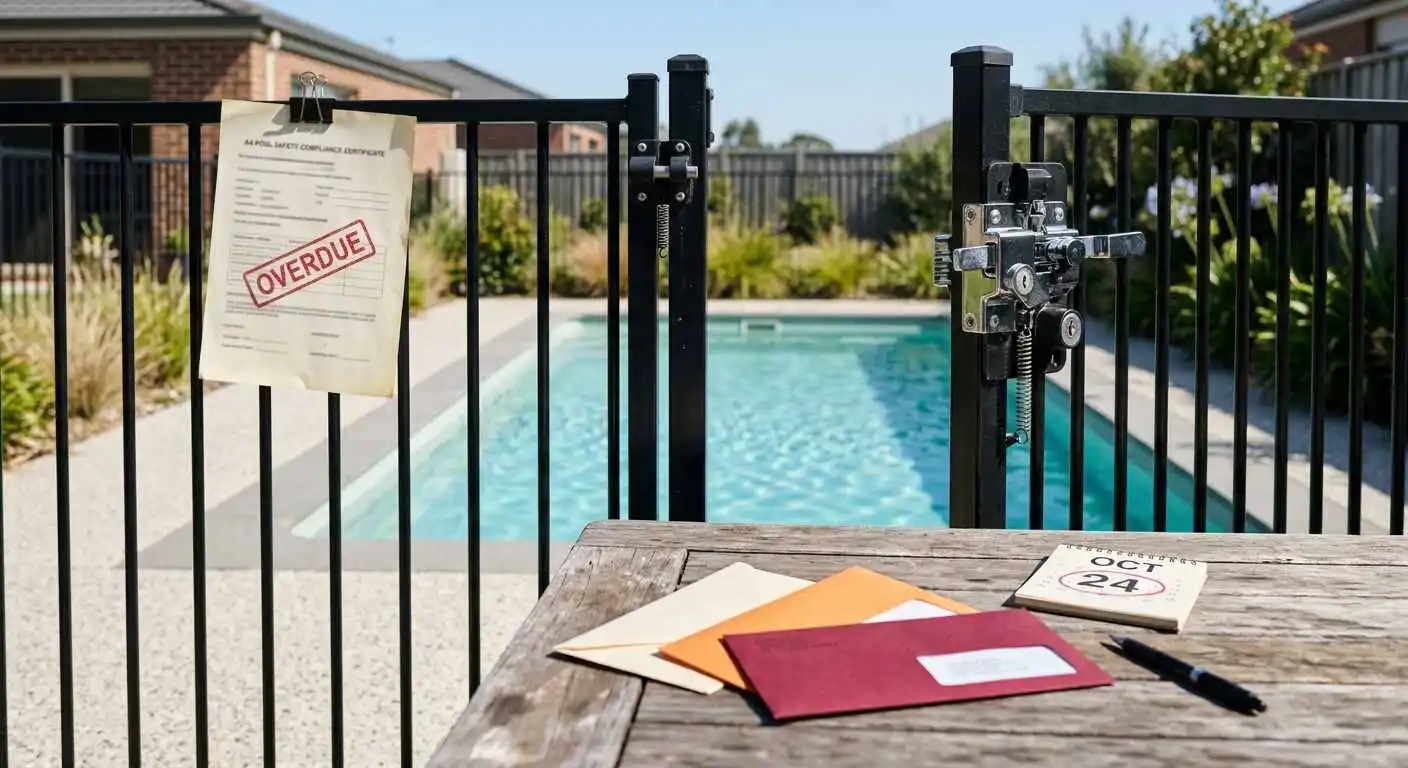
Pool owners in Victoria carry legal duties that most people never expect when they buy a home with a pool.
The Victorian pool fence regulations set several legal duties for pool owners, and one of the biggest is lodging your certificate of barrier compliance in Victoria (Form 23) on time.
A missed pool certificate deadline in Victoria, or a missed VBA pool deadline as many owners still call it, sets off a clear chain of steps.
Council usually sends a reminder first, then a Barrier Improvement Notice with up to 60 days to fix problems, and only then a fine.
You can stop the chain at any point by booking a registered inspector, getting a new Form 23, and lodging it with council within 30 days.
The order matters, because a fine usually comes last, after you have ignored the earlier stages.
What Happens When You Miss the Deadline?
- Council Reminder: Councils usually send a reminder about 60 days before your Form 23 expires.
A pool compliance certificate overdue after that puts you in a breach window, but you have no fine yet. - Barrier Improvement Notice: If you ignore the reminder, council can issue a barrier improvement notice that Victoria owners must act on.
It gives you up to 60 days to fix problems, so treat any council notice pool fence Victoria owners receive as urgent. - Infringement Notice: Failing to lodge a Form 23 can bring a fine of up to 10 penalty units, roughly $2,035 at the 2025-26 rate of $203.51.
The pool barrier certificate deadline penalty varies by council. - Legal Escalation: Ignoring a barrier improvement notice is an offence under regulation 147V(1) of the Building Regulations 2018.
- The 30-Day Lodgement Rule: You must lodge your Form 23 with council within 30 days of issue. Missing that is a separate breach.
Immediate Steps to Take
Act today, because every extra day you wait raises your risk of a fine. The fix is quick when you take it in this order.
- Book a Registered Inspector: They must be listed with the Building and Plumbing Commission (BPC). If your barrier passes AS 1926.1, they issue a Form 23 on the spot.
- Fix Defects Fast: If it fails, you get a Form 24 and typically up to 60 days to repair it. Then book a re-inspection.
- Lodge Immediately: Lodge within 30 days of issue, or 14 days after a barrier alteration.
- Handle Any Infringement Separately: Paying a fine does not replace lodging your certificate. You must resolve both.
Why the Deadline Exists (and Why Councils Enforce It)
The deadline exists to keep children safe around water.
Every pool or spa with a safety barrier needs a fresh check every four years, and the law requires councils to enforce that rule. If you miss it, you have breached the rules.
Under Victoria’s Building Act 1993 and the Building Regulations 2018, a registered building inspector must inspect every pool or spa with a safety barrier.
The owner then lodges a Certificate of Barrier Compliance, called a Form 23, with the council every four years.
In short, a Form 23 is your certificate of barrier compliance in Victoria, and it proves your barrier passed.
Owners must also follow mandatory pool registration rules, which are a separate step.
Once an inspector issues that certificate, the clock keeps running.
You must lodge the Form 23 with council within 30 days of issue. Missing the four-year renewal window is one breach. Missing the 30-day lodgement window is a separate one.
This is not a checklist your council made up.
It is a statewide safety framework, and the Building and Plumbing Commission (BPC) regulates it. The BPC is Victoria’s building regulator, and it took over from the Victorian Building Authority (VBA) in mid-2025.
The framework centres on AS 1926.1, the Australian Standard for pool fencing, gates, and barrier design. Councils have no say over whether to enforce it, because the law requires them to.
The law is strict for a simple reason.
Pool barrier failures are a leading contributor to toddler drowning deaths in Australia. Most failures come down to a gate that does not self-close, a gap in a fence panel, or a barrier that has aged out of compliance.
The four-year check exists because hardware loosens over time.
Gardens also grow around fences and quietly create climbable points. None of this is meant to scare you. It explains why the deadline is a legal duty and not a suggestion.
What Happens When You Miss the Deadline? The Three Outcomes
Most councils follow the same three steps. First comes a reminder, then a notice, then a fine.
You can stop the process at any step by acting, and the pool barrier certificate deadline penalty only lands at the last one.
1. A Reminder from Council
Most Victorian councils send a renewal reminder about 60 days before your Form 23 expires.
A pool compliance certificate overdue after that reminder usually puts you inside a breach window.
The good news is that no fine has been issued at this stage. Councils generally give owners a real chance to fix things first, so booking an inspection now is the best way to skip the next two steps.
2. A Barrier Improvement Notice
If you ignore the reminder, or council learns of a problem, the Municipal Building Surveyor (MBS) can issue a barrier improvement notice that owners must act on.
Council often learns of a problem when an inspector lodges a Form 24, the Certificate of Barrier Non-Compliance.
It can also learn through its own compliance check. The notice lists exactly what you must fix and sets a deadline of no more than 60 days.
Councils usually issue this notice for small, fixable problems.
Examples include a self-closing hinge that has failed, a gap under the fence, or a gate latch that sits too low.
It is a notice, not a fine. But under regulation 147V(1) of the Building Regulations 2018, failing to act on it by the deadline is an offence, and that leads straight to the third step.
Heads Up: Treat every council notice pool fence Victoria owners receive as urgent. The deadline on the page is the one that counts.
3. An Infringement (Penalty) Notice
Once a deadline passes with no lodgement and no repair, council can issue an infringement notice. Two separate breaches carry two separate costs.
- Failing to lodge a Form 23 by its due date can bring a fine of up to 10 penalty units, roughly $2,035 at the 2025-26 rate of $203.51.
- Failing to act on a Barrier Improvement Notice can bring an on-the-spot infringement, with more exposure if you still do not fix the problem.
Whether council fines you right away or follows up first varies by council.
Some go easy on a first lapse. Others move straight to enforcement, especially when the property has a history of non-compliance.
How Long Do You Have to Act Once You Get a Notice?
It depends on the notice. A Barrier Improvement Notice gives you up to 60 days. An infringement notice typically gives you 28 days to pay or contest it.
- Barrier Improvement Notice: up to 60 days from the notice date to fix the barrier and lodge a compliant Form 23.
- Infringement Notice: council sets the payment deadline in the notice itself, typically 28 days to pay or formally contest it.
- After any barrier alteration: you have only 14 days to lodge a new Form 23. A new fence panel or a replaced gate counts, because altering a barrier voids the existing certificate.
None of these clocks reset your original duty.
A notice does not give you a clean slate. It adds a new duty on top of the one you already missed. You still owe the original certificate, and the notice simply sets the timeline for handing it over.
What Do the Fees Actually Cost in Victoria?
A late Form 23 can cost up to 10 penalty units, which was roughly $2,035 in 2025-26.
Smaller admin fees add to that. Exact figures vary by council, so check before you pay anything.
Victoria sets most fines in penalty units, not fixed dollar amounts. The state government indexes the dollar value each July.
One penalty unit equalled $203.51 in 2025-26, and the rate rose to $209.10 from 1 July 2026. Older figures like $1,923 come from a prior year’s rate.
Here is how the ranges look for pool barrier compliance.
- Failure to register a pool or spa with council: some councils set this as low as 5 units. Several, including Hume City Council, apply the full 10-unit rate, roughly $2,035.
- Failure to lodge a Form 23 by the due date: up to 10 penalty units, around $2,035.
- Failure to act on a Barrier Improvement Notice: an on-the-spot infringement, with escalating exposure if it drags on.
On top of any fine, plan for smaller fees. Lodging a compliant Form 23 typically costs $20 to $22. Lodging a non-compliant Form 24 runs closer to $385 to $410.
A re-inspection after failed repairs generally costs $110 to $195 with most registered inspectors. For a fuller price breakdown, see our guide to pool safety inspection costs in Victoria.
Pro Tip: Exact dollar amounts differ slightly by council, and published fee sheets do not always show the current rate.
Check your council’s building services page or the BPC website before you treat any figure as final.
Step-by-Step: How to Get Back on Track After a Missed Deadline
If you searched for pool inspection deadline missed what to do, the short answer is to book an inspector today.
Then repair anything that fails and lodge the certificate with the council. Five steps get you there.
Step 1: Don’t Wait for Another Notice
A Form 23 pool certificate overdue by even one day is a breach, so move now.
Book an inspection the moment you notice the lapse. Every extra day raises your fine exposure and makes it more likely that the council’s next contact is a formal notice, not a reminder.
Step 2: Book a Registered Pool Inspector
Your inspector must be a registered building inspector or building surveyor listed with the BPC. They will check your barrier against AS 1926.1.
That includes fence height, gap sizes, self-closing and self-latching gates, and climbable objects nearby. If everything passes, the inspector issues a Form 23 on the spot, and you then have 30 days to lodge it with council.
See our pool inspection services and check our service area to find your suburb.
Step 3: If the Barrier Fails Inspection
If the inspector finds defects, they issue a Form 24 and a written notice of what needs fixing.
You typically have up to 60 days to finish repairs. Once the work is done, book a re-inspection. If the barrier now passes, the inspector issues a new Form 23.
Read the items that cause pools to fail inspection before you start repairs.
Try This: Walk your fence with a checklist before the inspector arrives. Test that the gate closes and latches by itself every time.
Step 4: Lodge the Form 23 with Your Council
Lodge within 30 days of the certificate’s issue date, or within just 14 days if it follows a barrier alteration.
Most Victorian councils now accept online lodgement through their building services portal. That is the fastest way to close out the duty.
Step 5: Deal With Any Infringement Notice Separately
If an infringement notice has already landed, paying or contesting it does not replace lodging your compliance certificate.
You must resolve both on their own. If you truly believe council issued the notice in error, you can apply for a formal review instead of simply paying.
Selling a Property With an Overdue Pool Certificate
An overdue Form 23 can slow your sale, but a non-compliant certificate still beats none.
You do not need a fully compliant barrier to sell in Victoria, but you do need a current Form 23 or Form 24 on record.
Victorian vendors must state in their Section 32 vendor statement whether the pool or spa is registered.
They must also say whether a current compliance or non-compliance certificate exists. A buyer’s conveyancer will flag an expired or missing Form 23 straight away.
That can slow or complicate a sale when you have the least room to move.
Pro Move: Don’t wait until settlement week. Book an inspection as soon as the property goes to market, so you have time to fix defects before contracts are exchanged.
A non-compliant certificate shows the required inspection took place. It also tells buyers exactly what they are inheriting, so no open question hangs over the sale.
For more on what trips sellers up, read about common pool compliance issues.
Fix It Now and Stop the Penalty Clock
A late certificate moves through three steps: a reminder, a barrier improvement notice, and then a fine.
Each step has its own deadline, and none of them cancel the certificate you still owe. Book a registered inspector, repair any defects, and lodge your Form 23 within 30 days.
Council always moves eventually, so make sure your paperwork gets there first.
Quick Answers to Your Missed Pool Certificate Questions
What if I never lodged my certificate and council hasn’t contacted me yet?
Silence from council does not mean you are in the clear. Missing the four-year renewal or the 30-day lodgement is a breach whether or not council has noticed yet. Book an inspection now and lodge the Form 23 before a notice or fine arrives.
Can I contest a pool compliance infringement notice in Victoria?
Yes. The notice sets your deadline, typically 28 days to pay or formally contest it. If you believe council issued it in error, you can apply for a formal review. Contesting or paying does not replace lodging your certificate, so you still need to resolve both.
How much does it cost to get a new Form 23 in Victoria?
Lodging a compliant Form 23 with council typically costs $20 to $22. The inspection itself is a separate fee, and it varies by inspector. See our pool safety inspection cost guide for current prices.
My barrier failed inspection. Do I still get fined for the original missed deadline?
Possibly. A failed inspection does not cancel the original breach, because the fine for a late Form 23 is separate. Whether council fines you straight away or follows up first varies by council. Fix the defects within the 60 days and book your re-inspection quickly.
Does the 4-year clock restart from when I lodge the late certificate?
Your research doesn’t cover this, so I haven’t written an answer. I don’t want to guess on a legal timing point. Please confirm it with the BPC or a council before publishing, or I can search for it if you like.
I received a Barrier Improvement Notice, but my contractor can’t start for 45 days. What should I do?
Act now, because a 45-day wait leaves very little of your 60-day limit for repairs, re-inspection, and lodgement. Look for another contractor who can start sooner. Also contact the Municipal Building Surveyor before your deadline to explain the delay. Missing the notice deadline is an offence under regulation 147V(1) and leads to an infringement.