
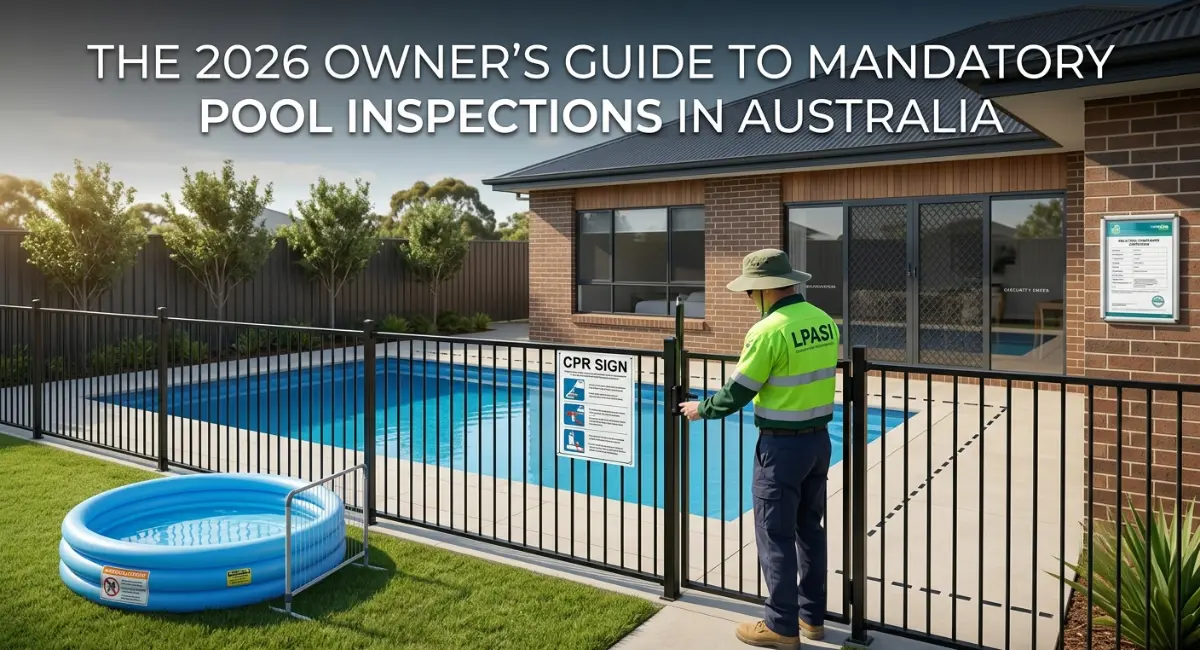
Pool inspections are legally mandatory in Australia to prevent accidental drownings, particularly of children under five. Over time, safety barriers warp, gates sag, and latches fail due to weather and wear. Regular inspections ensure your pool barrier consistently complies with strict state safety standards, keeping your family safe, protecting you from massive fines, and preventing complications with insurance or a property sale.
Owning a backyard pool is the ultimate Australian dream, but it comes with serious legal responsibilities. As we enter 2026, the laws around backyard swimming pools have never been tighter. If you are a property owner, understanding the rules around pool registration in Victoria and safety certification is no longer optional; it is a legal necessity.
Governments across Australia have shifted from simply recommending pool safety to strictly enforcing it. Failing to secure your safety certificate can result in massive financial penalties, blocked property sales, and canceled insurance policies. More importantly, an uninspected barrier puts young lives at risk.
At Local Pool & Spa Inspection, we have spent over 15 years inspecting pools across Australia. In this comprehensive 2026 guide, our expert team at LPASI breaks down exactly why these laws exist, what inspectors look for during an audit, and how to keep your family and property fully protected.
The Life-Saving Logic: Why the Government Mandates Inspections
Many property owners ask, “Why are pool inspections mandatory?” The answer is simple: to prevent accidental drownings. Safety barriers degrade over time due to weather, shifting soil, and general wear and tear. A fence that was safe five years ago might be a major safety hazard today.
The 30cm Rule: Why “Small” Pools Carry Big Risks
Many Australians do not realize that the law applies to more than just massive, in-ground swimming pools. Under the official Australian pool fence regulations, any backyard vessel that can hold 30cm (300mm) or more of water must have a compliant safety barrier. This includes inflatable pools, portable spas, and outdoor tubs. A child can drown in just a few centimeters of water in less than a minute, which is why these small water features trigger the exact same laws as a deep concrete pool.
Protecting the Under-Five Demographic
The primary goal of Australian pool safety laws is to protect children under five years old. Statistics show that accidental drowning remains one of the leading causes of accidental death in young children across Australia. A compliant safety barrier acts as a continuous silent guardian, buying parents crucial time if a toddler wanders outside unattended.
The Legal Shift from “Recommendation” to “Mandatory”
Years ago, keeping your pool fence upright was viewed as good advice. Today, the law treats it as a strict criminal liability. State governments have completely phased out old, uninspected legacy systems. If you own a pool or spa in Australia today, mandatory pool registration with your local council is required by law.
State-by-State Breakdown: Is Your Certificate Still Valid?
Pool safety laws are managed at the state and territory level, which means compliance timelines vary depending on where your property is located in Australia.
New South Wales: The 3-Year Validity and the Sales Trigger
When selling a property with a pool in NSW, you must attach a valid Certificate of Compliance to the contract of sale. In New South Wales, this certificate lasts for 3 years. If you are leasing your property, a valid certificate must be included in the tenancy agreement.
Victoria: The 4-Year Cycle and Mandatory Council Registration
Following major legislative changes, Victoria enforces a strict 4-year inspection cycle. Property owners must first complete their mandatory pool registration with their local council. Once registered, the council issues a deadline by which you must submit your pool safety compliance certificate (Form 23), which must be renewed every 4 years.
Queensland: Shared vs. Private Pool Timelines
Queensland operates under a single, unified pool safety standard. For private residential pools, a safety certificate is valid for 2 years. However, if the pool is a shared space (such as a motel, unit block, or caravan park), the certificate is valid for only 1 year and must be inspected annually.
Western Australia: Local Government’s Right of Entry
Western Australia takes a direct approach to safety. Local councils are legally required to inspect all residential pool barriers at least once every 4 years. To ensure these checks happen, authorized council inspectors have a legal right of entry to access your yard to view the pool barrier.
Summary of State Inspection Lifespans
| State | Certificate Validity Period | Key Compliance Trigger Points |
| New South Wales | 3 Years | Mandatory for selling or leasing a property |
| Victoria | 4 Years | Tied to fixed council registration deadlines |
| Queensland | 2 Years (Private) / 1 Year (Shared) | Must be provided when selling or leasing |
| Western Australia | Max 4 Years | Managed via automated local council audits |
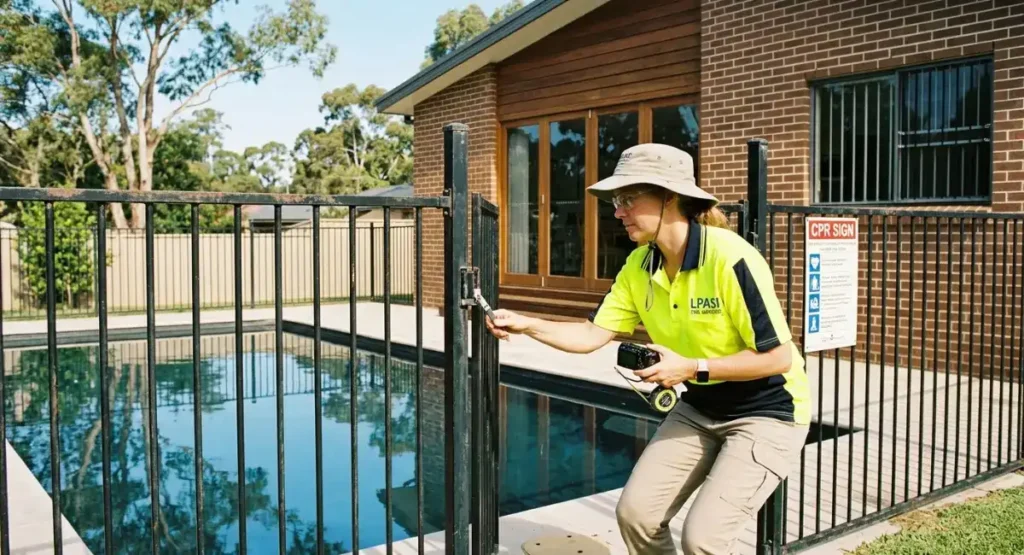
The Inspector’s “Hidden” Checklist: Real-World Failure Point
When our team at Local Pool & Spa arrives at a property, we look past the aesthetic design to check the precise engineering of your barrier. Many pools fail inspection on minor issues that owners miss, which is why reviewing a comprehensive pool compliance checklist before your audit is highly recommended. Here are the top four real-world failure points we encounter.
The Self-Closing Gate “Tug Test”
By law, your pool gate must open outwards (away from the pool area) and must self-close and self-latch from any position, even if it is only open by two centimeters. During an audit, an LPASI inspector will perform a “tug test.” We open the gate a fraction of an inch and let go. If the latch fails to catch automatically, the barrier fails. Gravity, worn-out springs, and rusty hinges are the most common causes of this defect.
Why 1.2m Isn’t Always Enough: The Boundary Fence Exception
The standard minimum height for an internal pool fence in Australia is 1.2 meters (1200mm) above the finished external ground level. However, if you are using a boundary fence (the fence shared with your neighbor) as part of your pool barrier, it must be at least 1.8 meters (1800mm) high on the inside of your pool zone.
The 90cm Non-Climbable Zone: Moving the “Invisible” Ladders
The Non-Climbable Zone (NCZ) is a 90cm semi-circle on the outside of your pool fence that must be completely clear of any objects that a child could use as a handhold or foothold. Property owners often fail this rule by placing “invisible ladders” near the fence. These include pot plants, barbecues, pool pumps, tree branches, steps, and outdoor chairs.
CPR Signage: More Than Just a Plastic Board
Every pool area in Australia must display a compliant resuscitation sign, ensuring it meets state-specific dimensions and visibility standards. It cannot be faded, hidden behind a bush, or tucked away in a shed. It must be made of durable, weatherproof material, measure the correct legal dimensions, and be easily readable from a distance of 3 meters by anyone standing inside the pool enclosure.
Beyond Fines: The Financial Risk of Skipping Compliance
Ignoring your pool compliance obligations carries severe real-world financial consequences that extend far beyond safety.
Property Settlement Delays: Why Solicitors Block Sales
If you attempt to sell a home without a valid compliance certificate, the buyer’s solicitor can halt the settlement process. In many states, a buyer can legally pull out of a contract entirely if a compliant pool certificate is not provided, leaving your property sale stranded.
Insurance Denials: The True Cost of a Non-Compliant Barrier
This is the biggest hidden financial trap for property owners in Australia. If an accident occurs in a pool with a known, non-compliant barrier, your home insurance provider may completely deny your claim. You could be held personally liable for millions of dollars in damages, medical costs, or legal fees.
Council Penalties: When Fines Exceed $5,000
Local councils across Australia have zero tolerance for unregistered or uncertified pools. On-the-spot fines for failing to register your pool or ignoring an inspection notice start at several hundred dollars and can rapidly escalate to court-imposed penalties exceeding $5,000.
Performance Solutions vs. Standard Fencing: Solving Complex Designs
What happens if your home has an unusual architectural design that makes standard fencing impossible? An LPASI inspector can help develop a Performance Solution. This is an alternative, engineered compliance path that meets the safety performance requirements of the Building Code of Australia without ruining your home’s aesthetic design.
Maintenance Hacks: Keeping Your Pool Safe Between Inspections
Securing your safety certificate is a major milestone, but compliance requires ongoing attention. Use these practical maintenance tips from our years of field experience to keep your barrier safe year-round.
- Weather-Proofing Your Latches and Hinges: Gates sag as seasons change. Check your gate latches every month. Apply a marine-grade lubricant to the springs and hinges to prevent rust and ensure the gate continues to slam shut automatically.
- Managing Non-Climbable Zone: Trees and bushes grow quickly. A small shrub can quickly become a sturdy climbing platform within your 90cm NCZ. Prune all overhanging branches and ground vegetation back to maintain a clear zone.
- Portable & Inflatable Pools: The Hidden Electrical Hazards: If you set up a temporary pool, keep it well away from outdoor power points, extension leads, and electrical equipment. Water and electricity do not mix, and temporary setups frequently present serious electrical shock risks alongside drowning hazards.
Final
Achieving pool compliance does not have to be stressful. When you understand the logic behind the rules, it becomes clear that these mandates exist to protect our families, our guests, and our financial assets.
By staying proactive with your mandatory pool registration and regular barrier maintenance, you protect your household and your property value.
If you need clarity on your local pool laws or want to ensure your barrier passes its next inspection seamlessly, book your audit with our professional pool safety inspectors today.
Frequently Asked Questions
Why are pool inspections mandatory in Australia?
Pool inspections are legally mandated to reduce accidental child drownings. Over time, pool gates, latches, and fences degrade due to continuous wear and exposure to weather. Regular safety audits ensure these barriers remain completely effective at blocking unsupervised access by young children.
How much does a pool safety inspection cost?
The cost of a professional pool safety inspection varies depending on your location in Australia, the size of your property, and whether it is a residential or commercial shared pool. Generally, a standard residential pool certificate price ranges between $150 and $350 AUD, depending on your local council requirements.
Does a portable or inflatable pool need a fence?
Yes. Under Australian safety standards, any portable or inflatable pool capable of holding 30cm (300mm) or more of water must be surrounded by a fully compliant pool safety fence. It must also meet the same registration and certification requirements as a permanent in-ground pool.
What is a non-climbable zone (NCZ) for a pool?
A Non-Climbable Zone is a 90cm (900mm) clear area on the outside face of your pool barrier. This zone must be completely free of any objects, such as tables, chairs, tree branches, taps, or pots, that a young child could use as a step or handhold to climb over the fence.
Can I inspect my own pool for a compliance certificate?
No. While you can use a checklist to self-assess your pool’s safety before a formal audit, you cannot issue your own official compliance certificate. Only a licensed, independent pool safety inspector or an authorized local council officer can conduct the inspection and issue a legal certificate.
How long does a swimming pool safety certificate last?
The lifespan of a compliance certificate depends on your state’s laws. For example, in New South Wales, a certificate lasts 3 years for private pools, and in Queensland, 2 years. In Victoria, you must submit a new safety compliance certificate to your council every 4 years.
What happens if my pool fails its safety inspection?
If you experience a failed pool barrier audit, the inspector will issue a non-compliance report detailing the exact failure points and what needs to be fixed. You are generally given a specific grace period (usually up to 60 days) to resolve the safety issues and book a re-inspection before the council is notified.
Are windows and doors allowed to open into a pool area?
Direct door access from a house into an outdoor pool area is generally banned for newer pools across Australia. Windows that open directly into the pool enclosure are allowed, but only if they are fitted with heavy-duty security bars or are restricted to open no more than 10cm (100mm) using a key-locked device.