
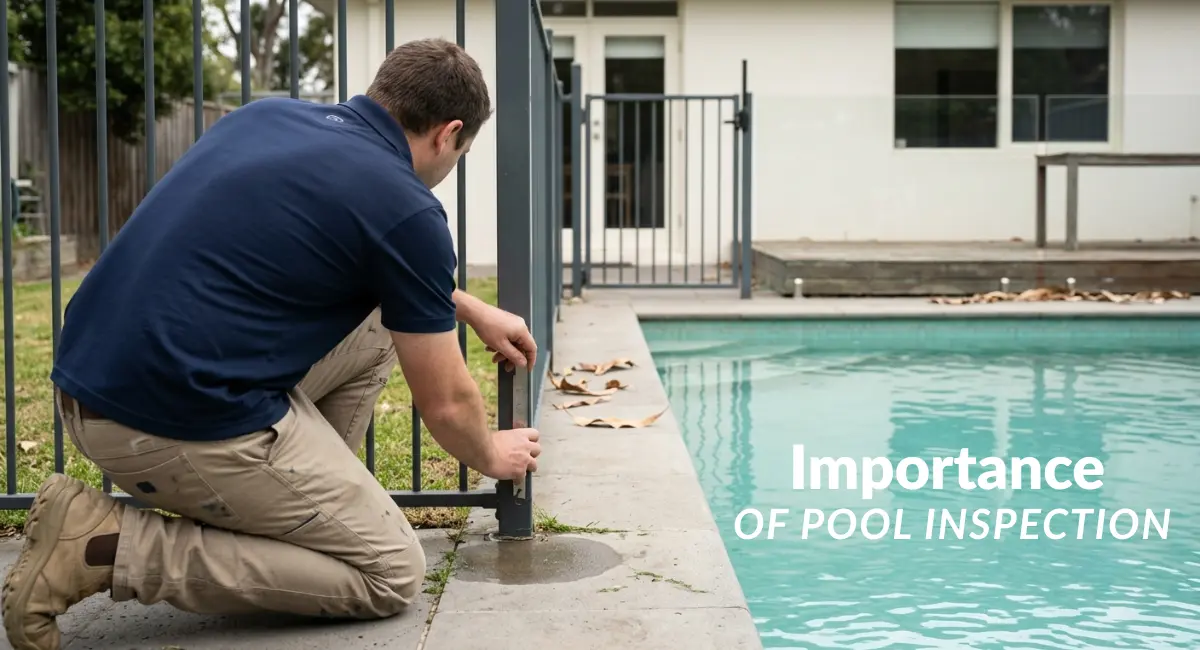
The importance of pool inspection is something most buyers discover the hard way, after settlement, when the pump fails, the fence fails its compliance check, or a structural crack that was there long before they signed turns into a $15,000 rectification job.
Most buyers assume a standard building inspection covers everything. It does not. General home inspectors assess roofs, foundations, electrical systems, and plumbing. Pools sit well outside that scope. Components such as pumps, filtration systems, electrical bonding, structural shell integrity, and pool barrier compliance all require a separate specialist assessment. Without one, major problems go completely undocumented.
Algaecides can make poorly filtered water look crystal clear within 24 hours. A fresh paint coat covers hairline cracks. A gate that fails to self-latch still looks solid unless someone tests it. Most buyers never do.
A professional pool inspection changes that. For buyers, it uncovers defects before they become post-settlement repair bills. For sellers, it removes the uncertainty that can delay or derail a transaction at the worst possible moment.
Across Melbourne and regional Victoria, the majority of pools fail their first compliance check, not because of major disasters, but because of minor oversights – such as breaching the mandatory emergency display rules – that quietly compound over time. A pool compliance inspection by a VBA-registered inspector finds those issues before they find you.
Why a “Clear Pool” is the Most Dangerous Thing You Can Buy
A sparkling pool sells dreams. That is exactly why it is dangerous. Clear water and tidy surrounds tell you nothing meaningful about what is happening inside the filtration system, behind the shell lining, or beneath the fence footings.
What you see on the surface tells you almost nothing about the condition underneath. Cosmetic work is cheap and fast. A few hundred dollars can make a 15-year-old pool look like a showroom feature. Sellers know this. What they cannot hide is structural movement, delaminating shells, corroded bonding wires, or suction fittings that have never met current entrapment standards.
The Misleading Aesthetic
Pool aesthetics are easy to manipulate before a sale. A chemical shock treatment can clear green water overnight. Freshly painted coping conceals surface cracks. A coat of pool paint hides worn surfaces. None of this addresses what is happening structurally or mechanically.
Buyers who buy on appearance alone are buying a risk they have not priced. The real condition of a pool lives in its mechanical systems, its shell, its bonding grid, and its compliance status, not in how blue the water looks on a Saturday afternoon open home.
The Cost of “Surprise” Repairs
Post-settlement pool repairs are among the most expensive property surprises a buyer can face. There is no recourse once you own the property. The costs land entirely with the new owner, and they add up fast.
| Problem | Estimated Repair Cost (Victoria) |
| Structural crack repair | $3,000 to $15,000+ |
| Full pool resurfacing | $8,000 to $20,000 |
| Pump and filter replacement | $1,500 to $4,000 |
| Electrical bonding rectification | $800 to $3,000 |
| Non-compliant fence rectification | $2,000 to $10,000 |
These are not edge cases. They are the findings experienced inspectors document regularly across Melbourne and regional Victoria.
Why New Pools Are Not Automatically Safe
A pool installed in the last five years is not immune to problems. Installation defects, incorrect bonding, and non-compliant barrier setups can occur on brand-new builds.
A pre-purchase pool inspection applies as much to a recently built pool as to one installed decades ago. A new pool with a compliance defect is still a non-compliant pool. Age is not a proxy for safety.
The Specialized Checklist: What Home Inspectors Miss
A general home inspector covers roofs, walls, foundations, and plumbing. Pool systems sit well outside that scope, and most home inspection reports say as much in their own disclaimers.
Most standard home inspections do not assess pools at all. When they do, the assessment is surface-level. A qualified pool inspector operates against a completely different set of comprehensive safety assessment criteria, requiring specialized technical knowledge of hydraulics, electrical bonding, suction entrapment, and barrier compliance under Australian Standard AS 1926.1-2012.
Understanding what pool compliance issues can cause helps buyers see exactly where general inspectors fall short.
Mechanical Systems and Automation
The pump, filter, heater, and any automation system present are the working organs of a pool. If any one of them is failing, the pool is not functional. A specialist inspector runs every component, checks pressure readings, assesses age and service condition, and documents what is approaching the end of life.
The pump and filter are the most expensive components to replace outright. Knowing their condition before purchase is not optional. Buyers who skip this check regularly discover they have inherited a failing filtration system within their first summer of ownership.
Structural and Shell Integrity
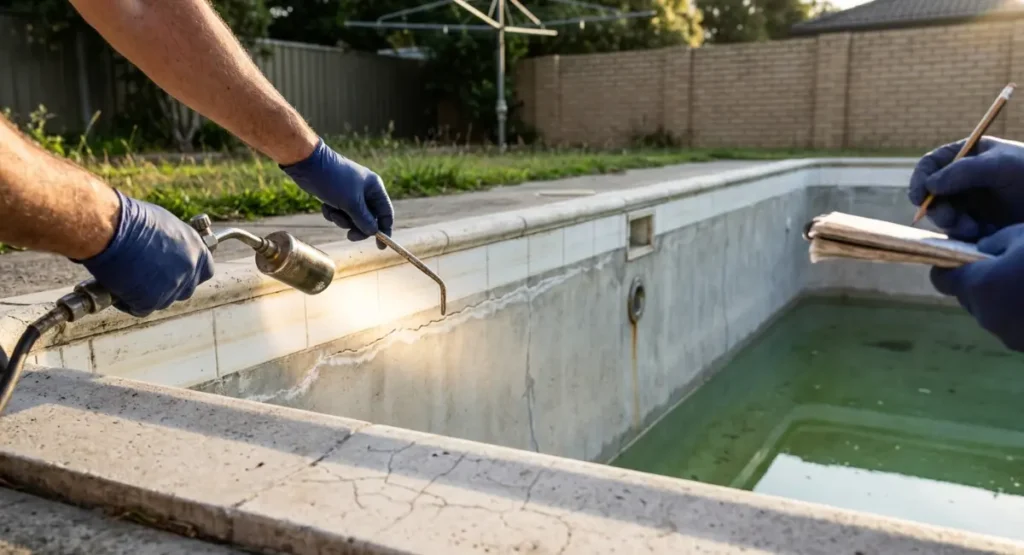
Inspectors assess the shell for delamination, surface cracks, and signs of hydrostatic pressure lifting. They check coping, tile, and the bond beam for movement. They look at the surrounds for trip hazards, deteriorating surfaces, and drainage that directs water back toward the pool area.
Concrete pools require resurfacing roughly every ten to fifteen years. Fiberglass pools show gel coat crazing as they age. Vinyl-lined pools face liner failure.
A specialist pool inspection identifies exactly where the structure sits in its service life, not just whether it looks acceptable today.
Electrical Bonding and Grounding
This is the single most dangerous item that home inspectors consistently miss, and it is invisible to the naked eye.
Every metal component in a pool, including the ladder, light fixtures, handrails, pump housing, and heat exchanger, must be bonded to an equipotential grid. If that bond is broken or absent, stray voltage can travel through the water. The result is electric shock drowning. A qualified inspector checks bonding and grounding as a first-priority safety item, not an afterthought.
Anti-Entrapment Compliance
Pool drain suction can trap a swimmer underwater in seconds. Anti-entrapment compliance requires correct drain cover design, dual drain configurations, and unobstructed flow. This is a life-safety item with zero tolerance for shortcuts.
Older pools are at particular risk because anti-entrapment standards have been updated significantly over the past decade. Pools that met the old standard may no longer meet the current one. A specialist inspector knows the difference and documents it clearly.
The Buyer’s Negotiation Playbook: Turning Findings into Credits
A pre-purchase pool inspection does not just protect you. It gives you documented leverage. When an inspector produces a detailed written report, you have professional evidence of every defect, and that report becomes the foundation of your negotiation.
If you are unsure how wide the range of pool compliance issues can be, or how they affect a transaction, the short answer is: far wider than most buyers expect. Buyers who go in without an inspection report negotiate blind.
The Repair vs. Credit Debate
Ask for a credit in almost every case. When a seller arranges repairs before settlement, they will choose the cheapest option available. You get a patch job on something that needed a full fix. When you take a cash credit, you control the quality of work done after settlement.
The one exception is safety-critical items. If a gate fails to self-latch, bonding is absent, or anti-entrapment covers are non-compliant, require written confirmation from a licensed tradesperson that the repair is complete and signed off before proceeding.
Common Deal Breakers
Some findings genuinely change the picture on a purchase. Major structural movement, suggesting the shell needs full replacement, electrical systems that have never been properly bonded, and plumbing failures that require excavation are not negotiating points.
These are re-evaluation triggers. A credit that covers the surface cost of a repair does not account for the disruption, the time, or the risk of further complications during rectification. Some pool defects are legitimate reasons to reconsider a purchase entirely.
Escrow Strategies for Winterized Pools
If the pool is covered or non-operational at the time of inspection, do not accept a deferred assessment. This is one of the most common mistakes buyers make and one of the most costly.
Have the pool made operational before inspection as a condition of the sale. If the seller refuses, negotiate a retention amount held in escrow until the pool is inspected in a fully running state. A pool that cannot be tested before settlement is a risk the buyer absorbs entirely. Do not absorb it without financial protection built into the contract.
The Seller’s Pre-Listing Advantage: Avoid the Closing Crunch
Sellers who act before listing hold every advantage. Sellers who wait until a buyer’s inspector finds problems are at the mercy of whatever that report says, under pressure, with the clock running.
A pool inspection before a sale is far easier to manage when you are in control of the timeline. Once a buyer is under contract, every day spent fixing pool issues is a day the deal could unravel. Getting ahead of that is not caution. It is a strategy.
Negotiating from Strength
When you have already fixed the problems, there is nothing to negotiate away. You walk into contract discussions with a compliance certificate in hand and a pool that has passed a professional inspection.
Buyers cannot use pool defects as leverage because there are none. That is a fundamentally different negotiating position than discovering problems mid-contract when you are already under settlement pressure, and every repair quote costs you time and credibility.
Building Buyer Confidence
Buyers in Victoria are increasingly aware that pools carry legal compliance obligations under the Building Act 1993, starting right from the initial official state registry requirements. A seller who presents a current Certificate of Barrier Compliance, issued by a VBA-registered inspector, signals a well-managed, transparent property.
Transparency about pool condition is now a marketing asset, not just a legal obligation.
Buyers who feel confident about what they are buying make stronger offers and fewer demands. That confidence comes directly from documented inspection results.
Disclosure Protection
If you are aware of a pool defect and choose not to disclose it, you carry legal exposure after settlement. Victorian sellers have obligations around material defects, and knowingly concealing a significant pool issue is not a strategy.
A pre-listing inspection with documented findings protects you by showing you acted responsibly. That paper trail matters if a dispute arises post-sale. Sellers who inspect early and act on the findings are in a far stronger legal position than those who did not.
Expert Tips: Avoiding the Nightmare Post-Purchase
The buyers who regret their pool purchase share a common story. They relied on visual impressions during the open home, skipped a specialist inspection, or accepted a verbal assurance from the vendor. Every one of those shortcuts is avoidable. None of them costs much to avoid.
Understanding the pool safety inspection cost in Victoria puts this in perspective. A few hundred dollars spent before purchase is a fraction of what a single missed defect can cost after it.
The Soil Movement Factor
Victoria’s reactive clay soils shift with moisture content across seasons. Pools built into ground that moves are subject to shell stress, pipe joint separation, and barrier footing movement. This is not visible from the waterline.
Soil movement is responsible for some of the most expensive post-purchase pool surprises inspectors see.
An inspector experienced in Victorian conditions knows which suburbs carry the highest reactive soil risk, what structural signs to look for, and where movement is likely to have caused internal damage that no visual inspection from the surface would reveal. This is a content gap almost every rival ignores. In Melbourne’s inner and outer suburbs, it matters enormously.
The Age vs. Life Assessment
Every pool component has a finite service life. Understanding where each component sits in that cycle tells you what costs are coming and roughly when. That forward view is what separates a useful inspection report from a checklist.
| Component | Typical Service Life |
| Concrete shell (to resurfacing) | 10 to 15 years |
| Fiberglass shell | 25 to 35 years |
| Pool pump | 8 to 12 years |
| Filter media | 5 to 7 years |
| Pool heater | 7 to 12 years |
| Pool fence (Colorbond/aluminium) | 20 to 30 years |
An inspector who understands the age-versus-life relationship gives you a forward-looking cost picture, not just a snapshot of today’s condition. That is the difference between knowing a pool is currently functional and knowing what ownership will actually cost you over the next five years.
Beyond the Inspection
A professional report is the starting point, not the end of due diligence. Once you have the report, request the pool’s service and maintenance records from the seller. Ask when the last chemical balance was professionally tested. Find out whether any significant structural or mechanical work has been done in the past three years, and ask for documentation.
A pool with consistent maintenance records costs less to own than one with none. Records also tell you whether the seller was actually on top of the pool or simply on top of how it looked before the sale.
Wrapping Up – Importance of Pool Inspection
The importance of pool inspection is clearest when you consider what it prevents. A pool that looked perfect at the open home but carried hidden defects is not a seller’s problem after settlement. It is the new owner’s bill, and it arrives fast.
For buyers, a professional pool inspection gives you real evidence to act on before you commit. For sellers, it removes the uncertainty that can hold up or collapse a transaction at the worst possible moment. For both sides, it replaces guesswork with documented fact.
No swimming pool inspection costs more than the repair bill you discover after it is too late to act.
If you own, are buying, or are selling a property with a pool or spa in Victoria, our team at Local Pool And Spa Inspection is fully VBA-registered, independent, and has inspected pools across more than 30 council areas from inner Melbourne through to Mornington Peninsula, Geelong, and Ballarat. We have no referral relationships with fencing or repair contractors. What we find is what we report.
Most Common FAQs on Essential Guide to Professional Pool Inspections
1. Can a standard home inspector inspect a pool?
Generally, no. Most home inspectors are not trained in pool systems. Pools require a specialist who understands mechanical systems, electrical bonding, structural integrity, and barrier compliance under the mandated Australian pool fencing standards. Book a separate pool inspector.
2. How much does a dedicated pool inspection cost?
In Victoria, a professional pool inspection typically costs between $200 and $500 depending on pool size and complexity. Council inspections cost more and take longer. See our full breakdown of pool safety inspection costs in Victoria.
3. What if the pool is closed or winterised during the home sale?
Have the pool made operational before settlement as a condition of sale. If the seller refuses, negotiate a financial retention held in escrow until the pool is inspected while running. Do not accept a covered or drained pool without a live test.
4. How long does a thorough pool inspection take?
Most pool inspections take 90 minutes to two hours. A written report covering mechanical, structural, electrical, and compliance findings typically follows within 24 to 48 hours.
5. Are pool safety certificates the same as a pre-purchase inspection?
No. A Certificate of Barrier Compliance only confirms the fence meets AS 1926.1-2012. A pre-purchase inspection covers mechanical systems, electrical bonding, structural condition, water quality, and anti-entrapment compliance. They are separate assessments.
6. What is the most expensive problem found during an inspection?
Structural shell failure requiring full replacement or major crack repair, often $15,000 to $50,000, depending on severity. Underground plumbing failures requiring excavation come second. Neither is visible without a specialist inspection.
7. Do I have to disclose pool problems if I am the seller?
Yes. Victorian vendors have legal obligations around material defects. Concealing a known pool defect exposes you to post-settlement claims. Non-disclosure is not a strategy. It is a liability.