
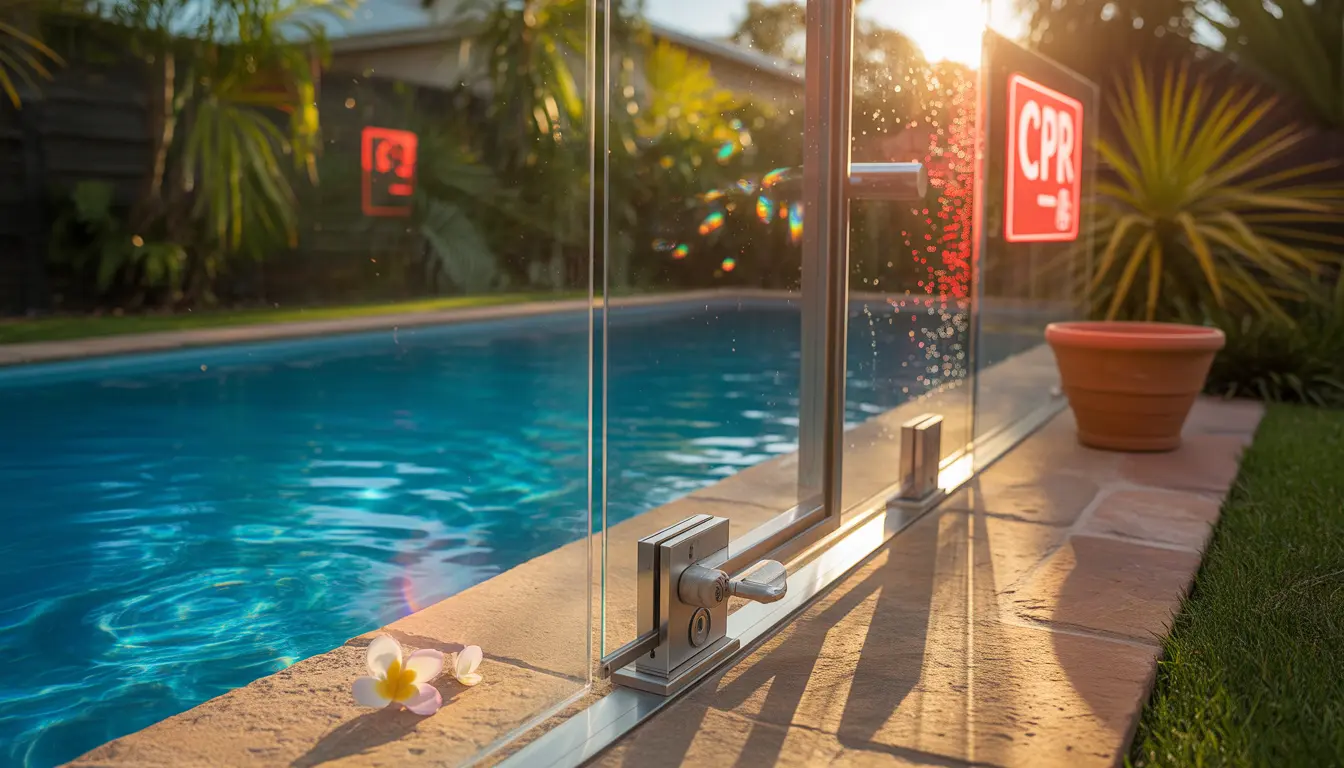
When your Pool Fails Inspection, it is a legal obligation that you respond to the safety breaches that were reported in your pool barrier rectification report within a given time.
Generally, Victorian laws allow a 60-day period to rectify the barrier to the required standard, e.g., AS 1926.1, the Pool Inspection Guide.
The owner must address all frequent safety barrier defects during this time, including repairing a failed self-closing pool gate and clearing non-climbable areas.
The window may result in a Form 24 (Notice of Non-compliance) and possible fines for non-compliance with pool safety.
Today’s guide discusses the financial pathway for re-inspection charges, the need for a VBA Registered Pool Inspector, and the need to successfully obtain your pool safety certificate (Form 23).
The 60-Day Clock: Understanding Your Legal Timeline
If your Pool Fails Inspection, you have only 60 days from the date of the first inspection to fix all safety-related problems and complete a successful reinspection.
It is a statutory requirement in Victoria that aims to determine that the risks of drowning are minimised as swiftly as possible.
The 60-day period starts when your inspector gives you the non-compliance report. It should be remembered that it is not 60 business days, but 60 calendar days.
Unless the repairs are completed and a second check is passed during this period, the inspector must, in legal terms, report the issue to your local council.
After the council consults, it can either issue an emergency order or an infringement notice. To prevent this, homeowners should consider the first 30 days as the action phase to create a buffer against delays due to weather or part availability.
Decoding Your Rectification Report: “Critical” vs. “Corrective” Fixes
A pool barrier rectification report is a technical document that breaks down the complex building codes into a list of necessary steps for your property. The report will serve as your key blueprint for getting compliant when your Pool Fails Inspection.
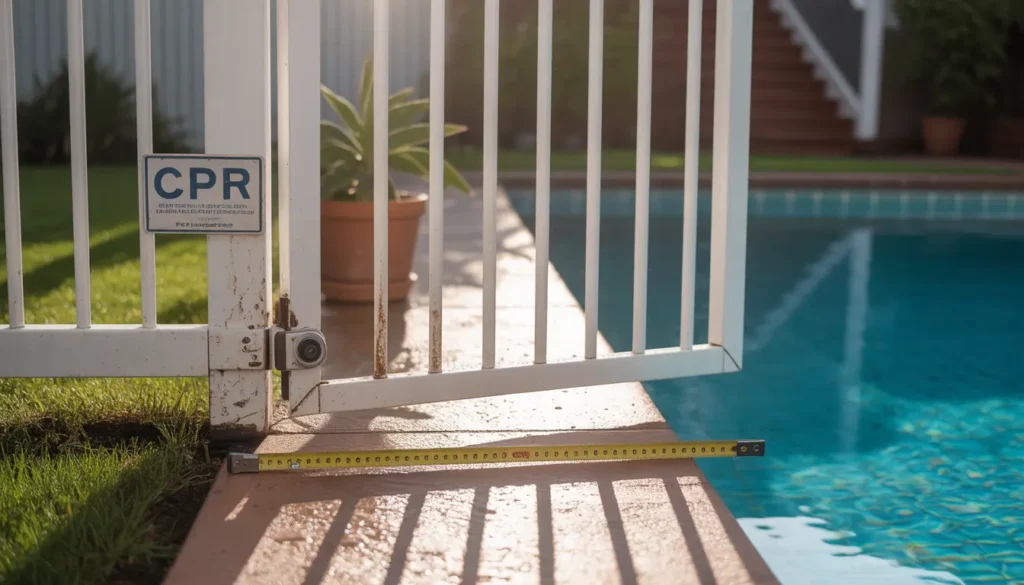
We commonly give these findings different names in the industry, terming them as “Critical Safety Risks” and “Corrective Maintenance.” The most critical risks are that the gate does not latch, and the gap between the fence and the water is more than 100mm, which may lead a Toddler to enter the water directly.
Fixes could take the form of overgrowth in the Non-Climbable Zone or a later sign that the CPR sign is faded.
The following difference will help you be more budget- and time-conscious with your contractor.
Even in the seemingly small part of the list, all items will be marked off so one can stop failing during a pool inspection and achieve a certified level.
| Issue Category | Example Problem | Required Action |
| Mechanical | Pool gate self-closing failure | Replace hinges or adjust tension immediately. |
| Structural | Loose fence posts or rusted pickets | Reinforce or replace sections of the barrier. |
| Zone Breach | Climbable trees or BBQ near the fence | Trim branches or relocate furniture 900mm away. |
| Administrative | Faded or missing CPR signage | Install a new, durable Australian Standard sign. |
Real-World Experience: Why Common DIY Repairs Often Fail a Second Time
Homeowners who have attempted an unsuccessful attempt to have a pool inspected typically attempt to save money by doing DIY pool repairs that are not successful in the reinspection of a pool inspection attempt created by the AS 1926.1 Pool Inspection Guide, as this would lack the precision needed to successfully pass the second attempt at a pool inspection.
An illustrative DIY solution for a dangly fence would be to install a standard garden latch. But new pool safety regulations require that the latches have a certain height and protection, so small fingers cannot reach through.
The second mistake is the wrong materials; in this case, the mesh is too soft, and a child can get a foothold.
Our pool compliance inspection Melbourne team has observed dozens of repaired fences breaking down, as the owner measured the fence at ground level rather than at the finished height.
The only solution is to hire a professional or utilize a comprehensive swimming pool compliance checklist to ensure your DIY work strictly adheres to current standards.
The Financial Roadmap: Fines vs. Re-inspection Fees
When a Pool Fails Inspection, the cost is doubled, including the cost of hiring a professional and possible government-issued non-compliance fines for a pool safety violation.
While follow-up professional pool safety assessment rates are usually less than the initial inspection charge, they still account for the professional’s time to return and verify the completed rectifications. It is a personal business charge.
Otherwise, the local council backs fines, which may exceed $1800 if the 60-day window is disregarded.
Rather than risk an infringement by the council, paying for a pool inspection reinspection with the hardware required is much more cost-effective.
Some inspectors offer a pre-inspection consultation, so your pool doesn’t fail on the first attempt, and you may even save the expense of several visits.
Booking Your Re-inspection: The Final Path to Certification
Formal follow-up is the final action after your Pool Fails Inspection and before repairs. The changes will have to be reviewed by your VBA Registered Pool Inspector, whom you must speak with to set up a time.
During this visit, the inspector will only focus on the previously non-compliant items, provided no new problems have arisen in the meantime.
After the inspector is persuaded that the barrier complies with the standards of AS 1926.1 Pool Inspection Guide, he/she will provide your pool safety certificate (in the form of Form 23).
The following document is your compliance form, which must be submitted alongside the lodging of your swimming pool council registration within the mandatory period to update your property status with the state registry.
Why “Near Enough” Isn’t Good Enough in Pool Safety
We can say near enough is sufficient in most instances when it comes to home renovation, but when it comes to your Pool Fails Inspection, it does not have to be near enough; there must be zero tolerance for errors. The law is black and white, which means either 100 per cent on board, or off-board.
This rigidity stems from the fact that a latched gate can only be said to be drowning when it is latched 99 times out of 100.
The pool barrier inspection Melbourne specialist utilises tools to measure force, gap width, and height.
When a gate needs the slightest touch to close, it is faulty. The insight into this way of thinking enables homeowners to understand why an inspector may seem picky.
They are not merely checking a box; they are making sure that the pool fence safety inspections they perform for Melbourne residents genuinely save some lives by eliminating any potential areas of failure.
The Most Common Culprit: Pool Gate Self-Closing Failure
Statistics indicate that one of the number one reasons why a pool fails an inspection in the entirety of Victoria is that the pool gate is not a self-closing gate.
Hinges are subject to loss of spring tension over time, and gates may fall down either as the earth moves or as they get heavy in use.
Regularly testing your gate can help prevent a collapsed inspection of your pool. Open it 10mm and release. It must latch. Unfold it, and release it. It must latch. Should it get stuck or fail to close smoothly, it should be addressed immediately.
Any weather variations affecting the city of Melbourne, and the shift in dry seasons to winter seasons, may influence the movement of timber posts, so routine maintenance is as important as a professional inquiry into the pool barrier.
Navigating the Non-Climbable Zone (NCZ) Requirements
The most misinterpreted part of the AS 1926.1 Pool Inspection Guide is the NCZ. When a Pool Fails Inspection because of an NCZ violation, it is certainly due to even the plant in a pot or a new outdoor bench.
The 900mm non-climbable space must be maintained at all times. It is an archway that is not visible and stretches down the fence.
In the case of a boundary fence less than 1800mm high, the NCZ is also required to be cleared on the neighbour side, presenting complex compliance challenges.
An inspection of pool barriers will identify these “footholds” and provide recommendations to relocate or cover them to prevent a child from climbing the barrier.
Future-Proofing Your Pool: Beyond the Form 23
Obtaining your pool safety certificate Form 23 is a big milestone, but compliance is a process rather than a goal.
Given that inspections are scheduled every 4 years, you are supposed to be in compliance year-round.
Prepare a folder containing your pool barrier mending report and your pool fence self-tests. Look at the front of your gate once a month and trim your trees away from the fence.
You guarantee the next time you engage a pool barrier inspection, you come out with flying colours, making the first attempt and also avoiding the hassle of failing a pool inspection just because you have neglected pool safety as part of home maintenance.
Final Thoughts on Achieving Compliance
Having your Pool Fails Inspection can be a frustrating and stressful experience, but it is also a vital opportunity to make your home safer.
By following your pool barrier rectification report diligently and respecting the 60-day rectification window, you can move through the process efficiently.
Remember, the goal of every VBA Registered Pool Inspector is to ensure that your backyard remains a place of fun and relaxation, free from the tragedy of preventable accidents.
Start your repairs today, book your pool inspection/reinspection early, and secure your pool safety certificate (Form 23) to enjoy your summer with total peace of mind.
Frequently Asked Questions on Pool Fails Inspection
How long do I have to fix my pool fence if it fails an inspection?
You have a maximum 60-day rectification window in Victoria to fix any issues identified by your inspector. If you do not pass a pool inspection reinspection within this timeframe, the inspector is legally required to notify your local council.
Can I be fined immediately after a failed pool inspection?
No, you generally won’t be fined immediately by the council. The inspector provides a 60-day window for you to make repairs. However, you can face pool safety non-compliance fines from the council if you fail to act within that 60-day period or if your pool is deemed an immediate, life-threatening risk.
Do I have to pay for a second inspection if the first one fails?
Yes, most VBA Registered Pool Inspector professionals charge a re-inspection fee. This covers their time and travel to return to your property and verify that the items in your pool barrier rectification report have been properly addressed.
What are the most common reasons for a failed pool inspection?
The most frequent reasons include a pool gate self-closing failure, climbable objects (like BBQ sets or furniture) within the 900mm Non-Climbable Zone, and gaps under the fence exceeding 100mm due to soil erosion.
Can I perform the pool barrier repairs myself to save money?
Yes, you can perform the repairs yourself. However, many DIY repairs lead to a second failed pool inspection because the work doesn’t meet the precise measurements required by the AS 1926.1 Pool Inspection Guide. It is often safer and more efficient to hire a specialist.
What is a Certificate of Barrier Compliance (Form 23)?
A pool safety certificate Form 23 is the official document issued by a registered inspector confirming that your pool or spa barrier meets the required safety standards. You must lodge this form with your local council to remain legally compliant.
Is a spa required to have the same safety fence as a pool?
Yes, in Australia, any spa (including swim spas and portable hot tubs) capable of holding more than 300mm of water must have a compliant safety barrier that meets the same standards as a swimming pool.